
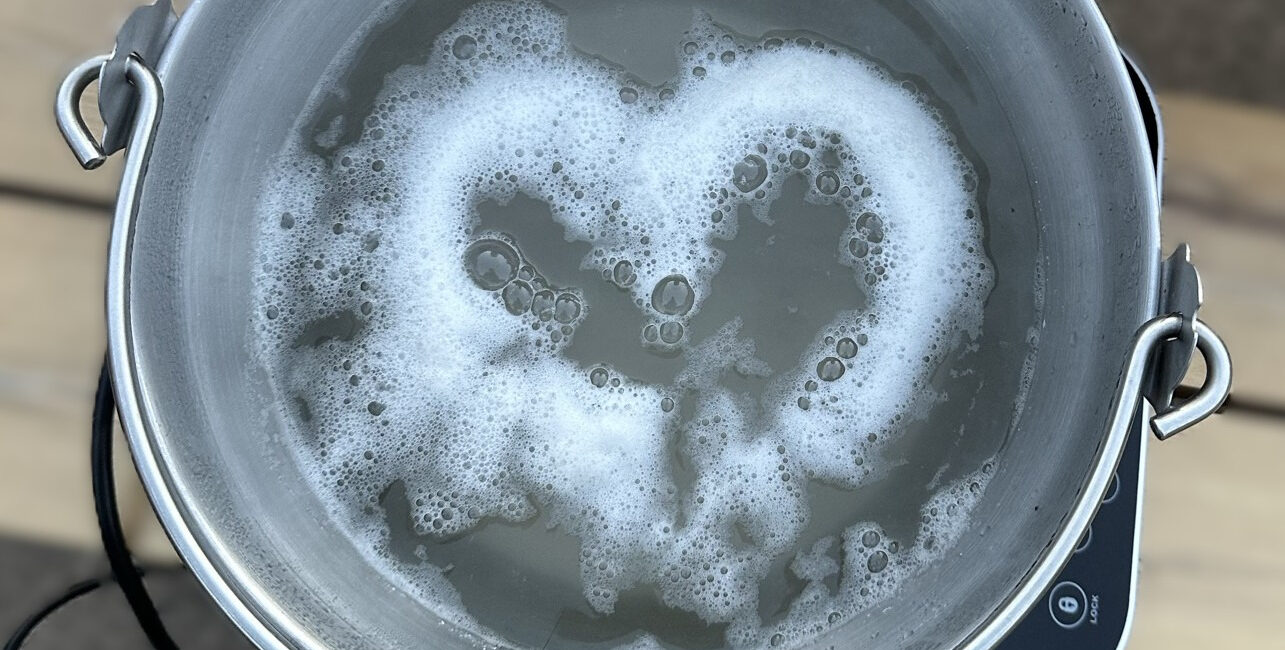
Minnesota love showed up in Dan Fergus’s syrup processing this year. Courtesy of Dan Fergus.
Residents took advantage of nature’s early spring treasure through this storied Minnesota tradition
By Kat Ruth-Leigh — Volunteer contributor
This spring, Roseville residents continued the long Minnesota tradition of collecting sap and processing it into maple syrup.
Known to have originated in Ojibwe communities, tree tapping became widespread during World War II when limited sugar rations made alternative sources more attractive. Today, even without sugar rations to worry about, the practice continues.
Each year, the season starts when temperatures peak above freezing during the day and then drop back down below freezing at night, according to the Minnesota Department of Natural Resources. In 2026, the optimal temperature variation started pushing the sap out of trees in force around mid-March.
This timeline means Interested tappers need to identify a tree before they can see the shape of its leaves. To do so, they can look for bark that curls apart with a texture that looks similar to bacon. Any kind of maple tree or box elder tree produces sap that is suitable to boil into syrup.
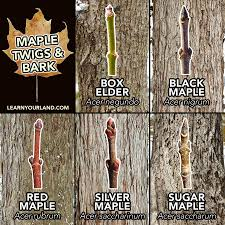
Roseville Parks Department employees ask residents to follow general guidelines for selecting a tree of the right size and good health. To tap trees on private property, you need permission from the property owner. Trees on city-owned property fall under rules that restrict damaging trees, so any trees in public parks or boulevards are off limits.
Dan Fergus of Roseville began tapping two trees in his front yard near Roselawn Cemetery in early March.
“The last few years haven’t had a great yield, because the winters were so warm,” Fergus said. By early April of this year, however, this season had shown itself to be much more favorable.
“This has been a fruitful season,” Fergus said. “I’ve processed about 14 pints of syrup. I would have had two to four more but lost a couple because of days I couldn’t process the sap in time.”
John Nelson has been tapping a tree in his front yard near Autumn Grove Park for about ten years now.
“I’ve collected forty gallons of sap since Thursday,” said Nelson on a Sunday toward the end of March. He was in the middle of the first stage of processing, boiling the sap down into concentrated syrup. Nelson’s setup on his front lawn includes a large metal tub heated by propane that he monitors with a remote thermometer to make sure the sap is heated just right.
Sap was still running steadily when the Harriet Alexander Nature Center hosted Tapping Time, a community event educating the community about tree tapping on March 28 and 29. Interactive stations took visitors step-by-step through the whole process, from identifying a tree, collecting sap, processing, filtering and then tasting the final product.
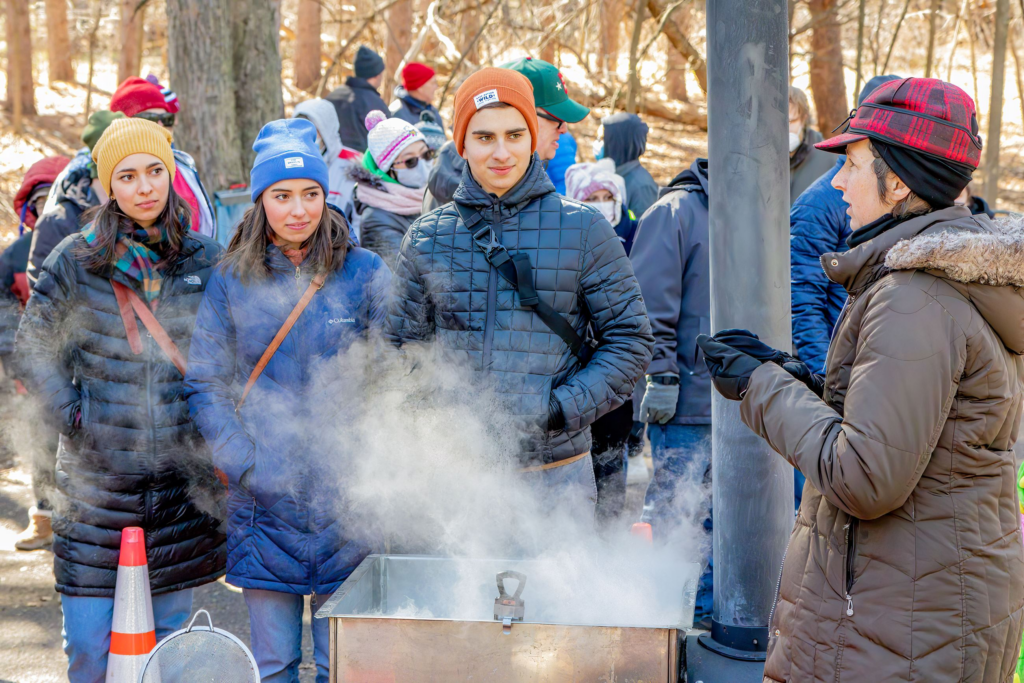
The event has occurred annually for over a decade, according to HANC Director Deon Haider.
“The goal of the event is to introduce the community to the long tradition of maple syrup tapping,” he said.
Like the volume of sap collected, community attendance at the event from year to year is dependent on the weather. Good weather years might see 1,200 people cycle through the event over the course of two days.
And what do Roseville residents do with nature’s bounty after the season is finished? The syrup processed at Tapping Time is only used during that weekend for education. Nelson enjoys his syrup through the year, while Fergus likes to give some of his syrup away.
“It’s a really nice thing to be able to give as teacher gifts or thank you presents throughout the year,” Fergus said. “This year, I’m sending it to people out of state who supported our community during the [Immigration Customs and Enforcement] (ICE) surge.