

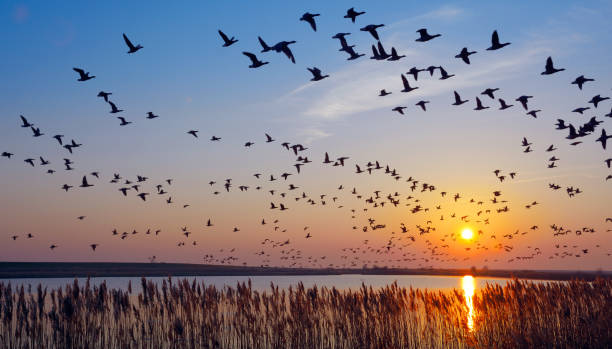
During the Fall bird migration, millions of birds fly over Minnesota. Here’s how we can accommodate our avian friends’ annual flight in a changing world.
By Carly Aulicky — Volunteer Contributor
The Minnesota State Fair is a human demarcation of the changing seasons. As it winds down the tail end of summer with food trucks, livestock and festivities, families begin the resumption of fall back-to-school routines. More subtly, the temperatures have begun to change, and the flush of summer blooms begin to fade as the days and nights cool.
Another subtle sign of the changing seasons, and one of the most anticipated, is the biannual migration of birds. Here in Minnesota, fall migration began just before the state fair, with Minnesota breeding birds such as warblers and orioles beginning their long flights back to the Southern states, Mexico and South America. Minnesota falls within the Mississippi Flyway, one of four common pathways taken biannually by large numbers of migratory birds. During peak periods of migration, Cornell University’s BirdCast estimates over 12,000,000 birds pass over the state.
Humans have long been fascinated by birds and flight, although it was not until the 1800s that Western science documented evidence of bird migration. Prior to that time, it was a common belief that most birds hibernated out of sight and reemerged with warmer weather. By the end of the 1800s, evidence of migration and interest in understanding the movements of birds increased, and migration has remained a subject of intensive study since that time. Scientists hypothesize that birds have been migrating for hundreds of thousands of years.
Research has illuminated incredible physical feats undertaken by birds to move thousands of miles, and has shown that most of those species are migrating at night. In fact, research suggests that approximately 80% of birds migrate mostly at night. It is believed that birds use a combination of navigation tools to make these long night journeys, including using the positions of landmarks, astrological features and the Earth’s magnetic field.
In the millennia since birds began taking these long, physically intensive red-eye flights, the nighttime world has undergone drastic changes. Electricity has become readily available, and the constant and powerful interjection of light has remarkably impacted the nightlife of the natural world, including migration. The intense light pollution from major cities can disorient birds on the wing, causing them to waste precious energy circling in and out of light point pollution.
Once such example takes place twice yearly in New York City, where the powerful blazing lights used to memorialize the Twin Towers in the Tribute in Light disorient migratory birds. The Tribute in Light has been the subject of research for the effects of artificial light on birds by the Cornell Lab of Ornithology, which found the beams attract bird densities up to 150 times higher than when the lights are not turned on. Researchers and volunteers monitor the light beams every 20 minutes and determine when enough birds have become trapped to temporarily shut off the lights to release the birds stuck inside the disorienting beams.
Another more common example of nighttime disruption is the typical city skyscraper, lit up to showcase a city’s skyline. In Galveston, Texas, the lights from a 32-story skyscraper caused 395 bird collisions during the fall migration of 2017, where all but three birds found the following morning were collision fatalities. After this event, the building adopted The National Audubon Society’s Lights Out Initiative best practices and helped trigger different light practices during bird migration in Galveston.
Lights Out is an effort led by Audubon to protect migrating birds by reducing points of light pollution. Participation is easy and voluntary— corporate buildings and other large sources of light pollution sign up to be reminded when to turn off unnecessary lights during peak migration seasons for their area. Here in Minnesota, the state Audubon Society leads Lights Out Minnesota, reminding buildings of best practices after completing a simple participation form. The Department of Natural Resources also encourages Lights Out Initiative participation in the Lights Out Initiative participation in the Twin Cities, and lists participating organizations and buildings.
Here in Roseville, as fall migration picks up in the coming weeks, we as citizens and business owners have a chance to protect the millions of migratory birds passing over our city. Encourage multistory buildings and big complexes to adopt Lights Out practices, and seek ways to reduce the light impacts of your home by shutting down lights between midnight and dawn. Share with your neighbors and favorite businesses how something as little as turning a light switch can have tremendous impacts, and remember to enjoy migration!
Carly Aulicky can be reached at caulicky@gmail.com











Thanks for a great article!