Though made out to be monstrous, silkspinners tend to mind their business
By Meghan Cassidy — Roseville arachnid enthusiast and naturalist
It’s spooky season again, and as you drive around our cozy city of Roseville you will likely see your neighbors begin to hang up decorations, often of the macabre variety. They likely also showcase creepy, crawly animals like spiders. Spiders and their webs are one of the most popular Halloween decor items. We often lump these beneficial eight-legged animals into “scary” categories that include ghosts, zombies and other monsters and ghouls, but do spiders really deserve to be included there?
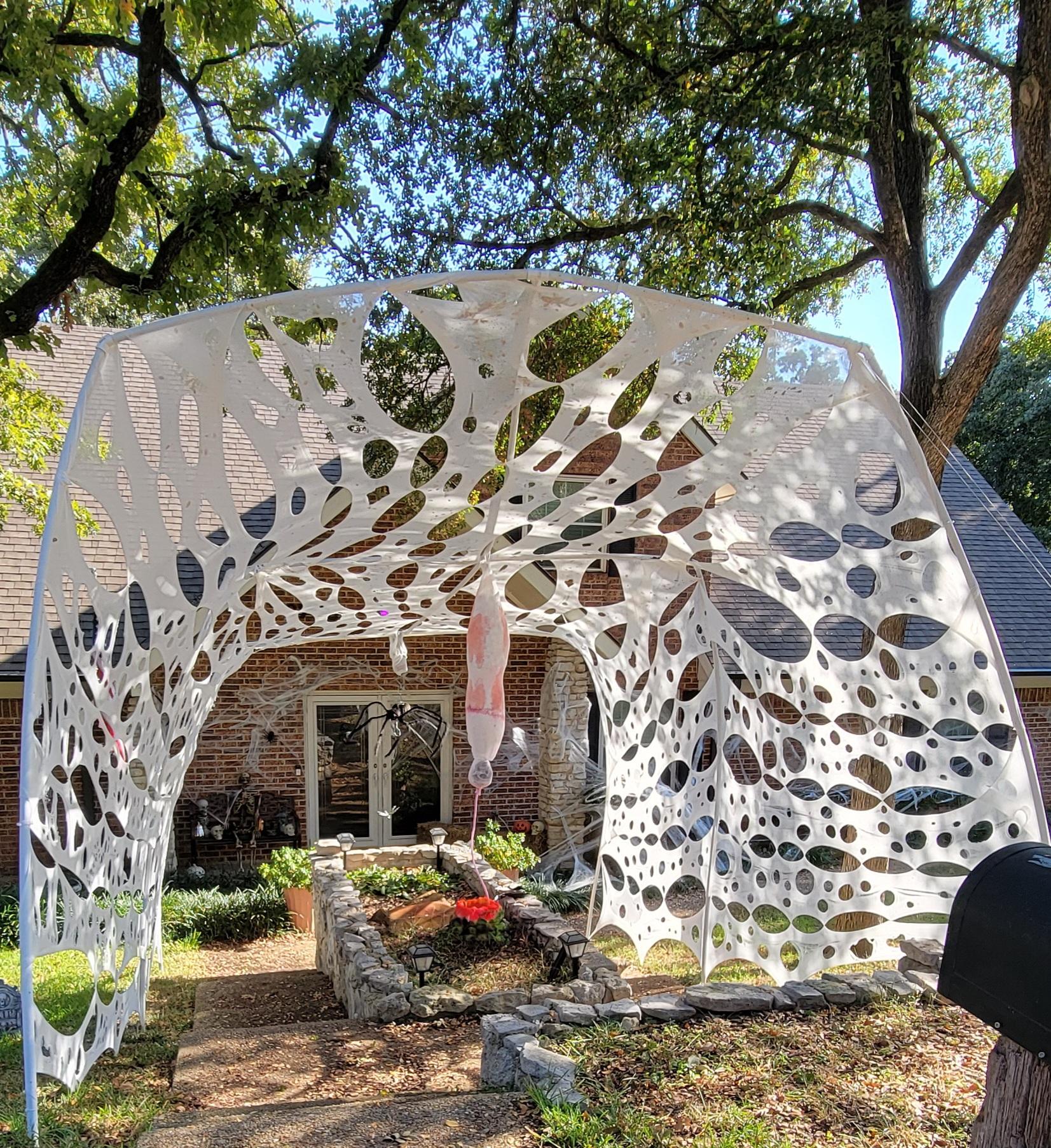
Halloween decor outside of a house shows a human wrapped up for a spider’s meal. Photo by Dick Schoech.
From hyped news articles to sensationalized visual media, spiders have gotten the short end of the stick. News articles often portray spiders in a negative light, deeming them to be nothing more than monstrous beasts that are capable of undue personal harm, and often with the intent to tap into our emotions by eliciting fear and shock. A recent example that has hit headlines in the United States over the last few years is about the introduced Joro spider (Trichonephila clavata), a type of orbweaver spider in the family Araneidae. Which of these headlines do you think will get more clicks and traffic, “Giant Spider species that weaves enormous webs has invaded the U.S. ” or “Joro spiders aren’t scary. They’re shy”?
These sensationalized articles not only use a fear factor to drive readership, and are often rife with misleading or completely incorrect information about spiders, even proliferating urban legends that have been debunked. Now, while we do not have any Joro spiders up here in Minnesota, we do have over 40 species of orbweavers and over 400 total species of spiders residing in our state!
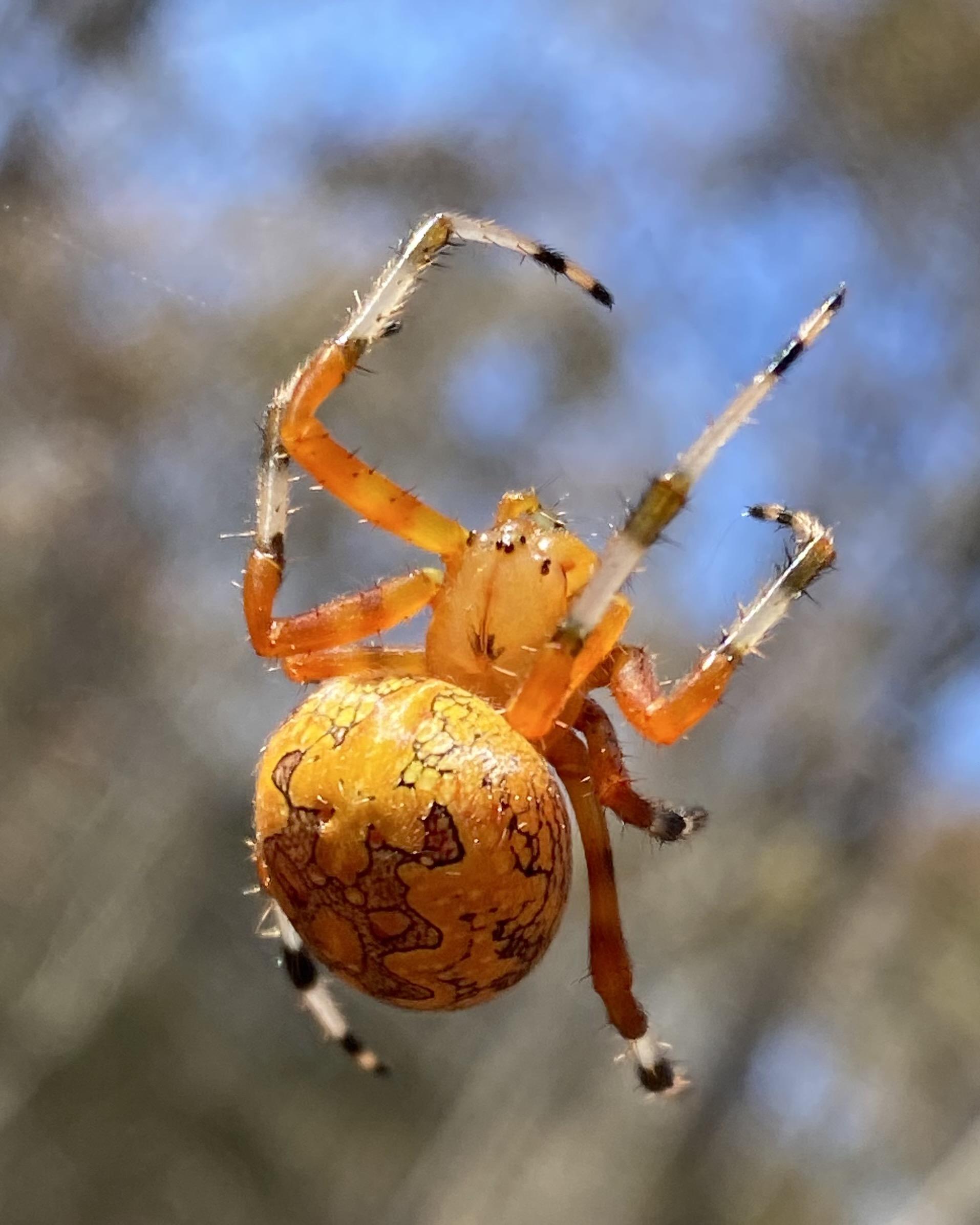
Marbled Orbweaver (Araneus marmoreus) dangling from silken thread. Photo by Meghan Cassidy.
Only monsters in the movies
In movies, spiders are again often portrayed in an unfavorable way, usually as monsters or villains, such as with the character Shelob in The Lord of the Rings movies (and books). Shelob is a massive, dangerous spider-like monster with multiple huge fangs (many more fangs than real spiders have) that attacks the main character, Frodo. She even has a huge “stinger” in the rear of her abdomen she uses to inject venom, which real spiders do not have. Instead, at the end of a spider’s abdomen you will find their spinnerets which are essentially little spigots they use to release silk. Shelob stabs Frodo with this large stinger, paralyzing him, and then wraps him up for later. In this series, Shelob is seen as being a symbol of pure evil and darkness. In reality, spiders simply want to eat lots of bugs and hide from their predators, like birds, snakes and even humans. Spiders are reclusive by nature, and really want nothing to do with us. And you certainly do not have to worry about your local spiders coming out of a dark cave to eat you— humans are not on the menu!
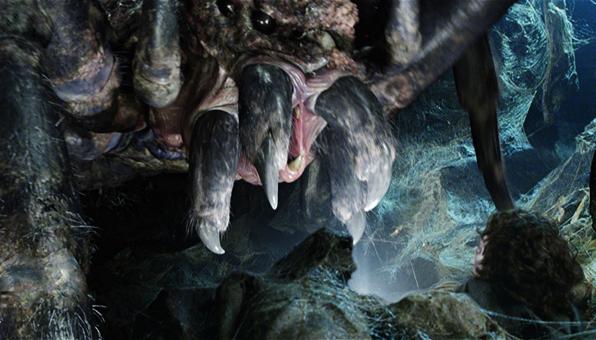
Shelob from the Lord of the Rings. New Line Productions, Inc.
There are also movies made specifically about how scary spiders are like the 2002 movie “Eight Legged Freaks,” where normal spiders are exposed to toxic waste that turns them into giant monsters that begin to prey on humans! While humans are not a prey item to any spiders, movies love to show this. What spiders do like to eat are insects, and they eat TONS of insects! Recent estimates show that spiders eat more than 400 million tons of insects each year. Overall, all spiders act as a free, natural source of pest control.
Horror movies like “Eight Legged Freaks” also put spiders into a monstrous scale, when in fact the opposite is true. We are comparatively massive to all spider species, and you would be hard pressed to find a spider larger than about one inch in body length here in Minnesota. In fact, most Minnesota species are relatively small, some being as tiny as a couple millimeters! For spiders, the humans passing by are the Godzilla-sized creatures to be cautious around as they will often harm or kill them out of fear.
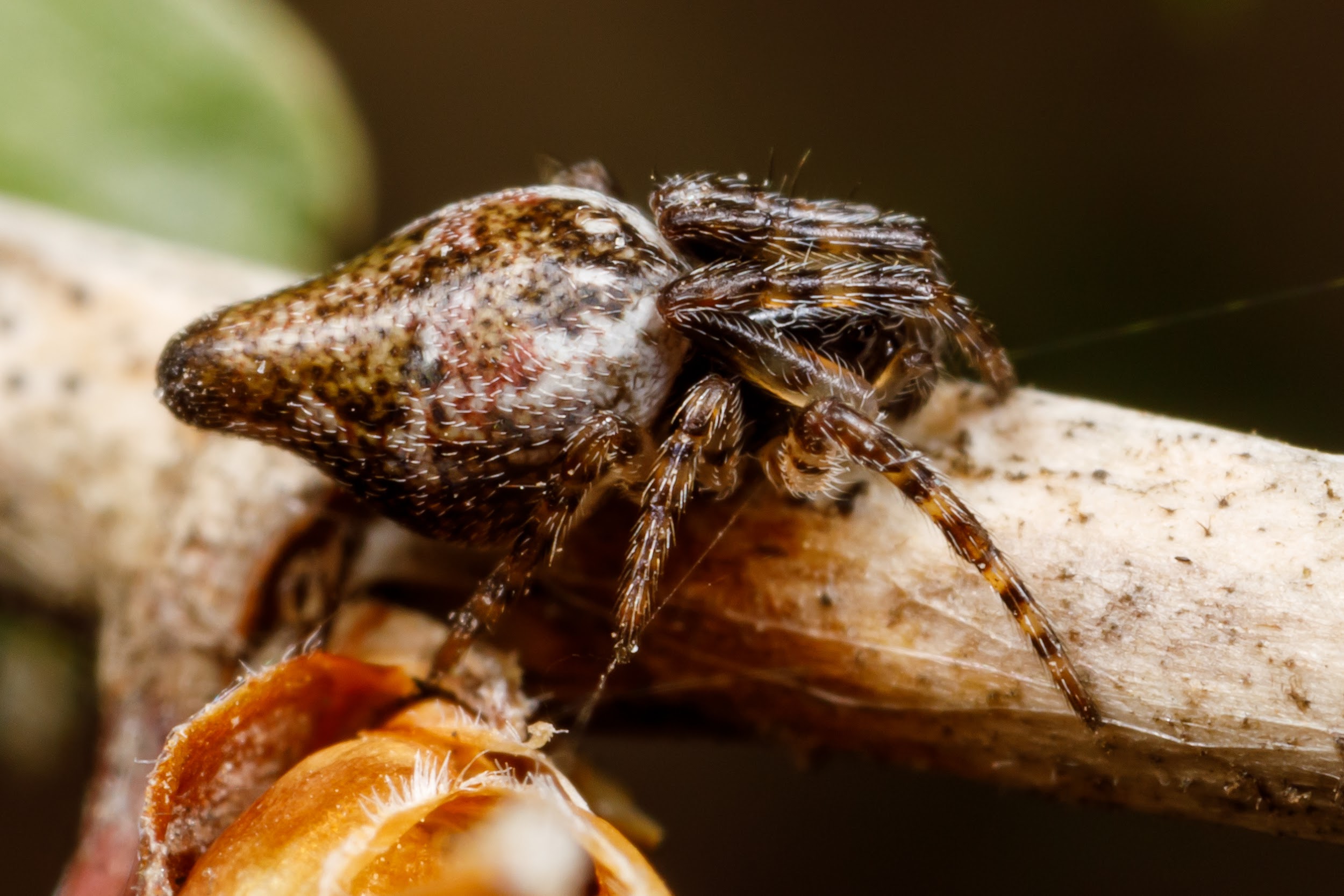
A Trashline Orbweaver (Cyclosa sp.) protecting herself with her legs. Photo by Meghan Cassidy.
The truth about spiders
The main prey item of spiders are insects, and spiders are very efficient hunters that employ multiple methods to capture their prey. While all spiders produce silk, not all spiders use their silk to spin webs. Spiders are a very diverse order of animals with over 52,000 described species worldwide. They come in a massive variety of body shape, size, coloration and hunting strategy.
You are probably used to seeing orbweaver webs, those large, spiraling webs with concentric lines that often appear as the sun is going down, but orb webs are only one method of hunting that spiders employ. With orb webs, an unsuspecting flying insect careens into a strand of the sticky silk and gets stuck. Then the orbweaver quickly climbs across the web, injects the prey with venom to subdue it and wraps it up to feed. If the web becomes damaged during this feeding endeavor, the spider will take the time to repair her web to ensure it will continue to effectively capture more prey.
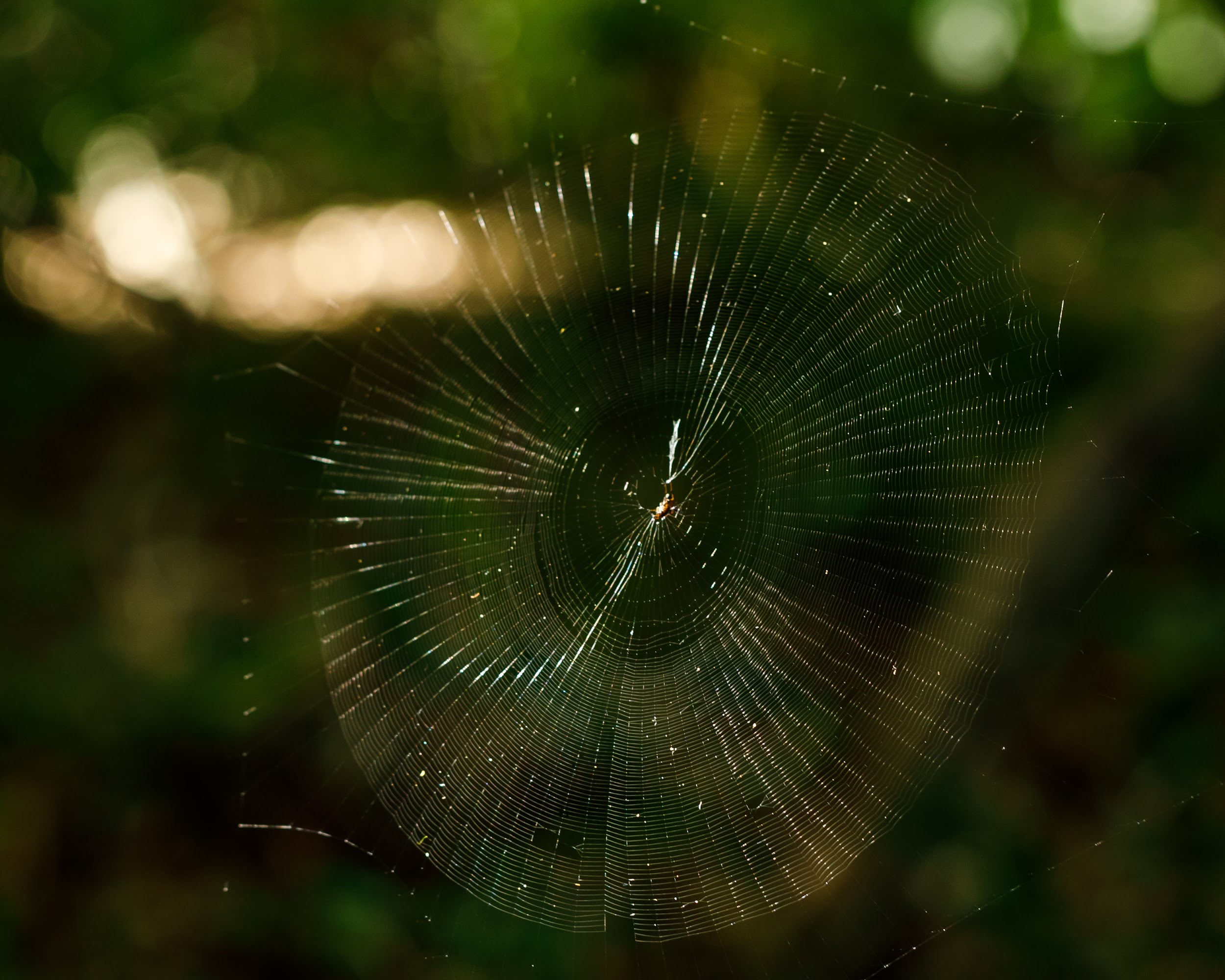
The orb web of a Spined Micrathena Orbweaver (Micrathena gracilis). Photo by Meghan Cassidy.
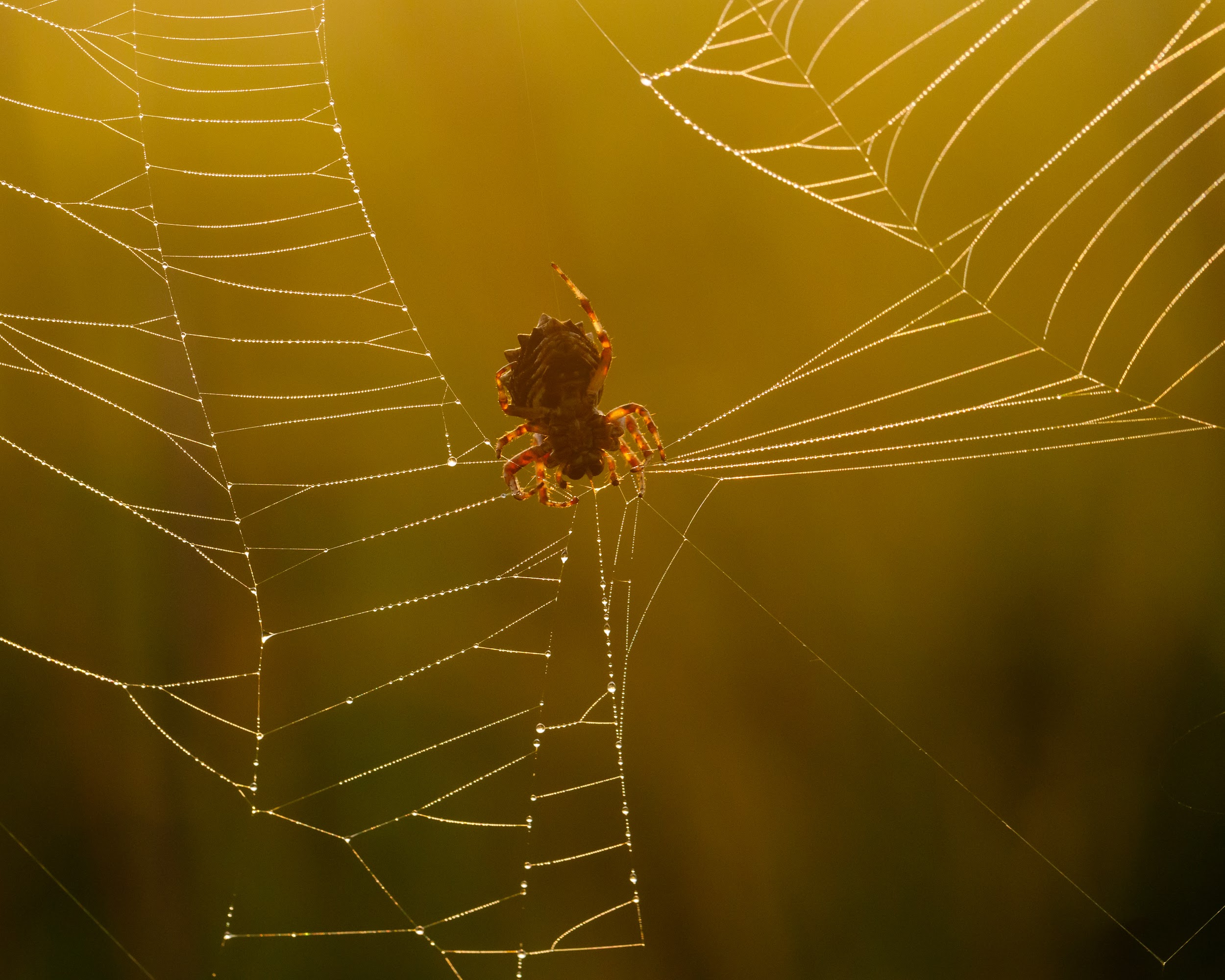
A Starbellied Orbweaver (Acanthepeira sp.) repairing her damaged web in the early morning. Photo by Meghan Cassidy.
Another family of spiders that spins webs, but not orb webs, are the funnel weaver spiders in the family Agelenidae. These spiders use their elongated spinnerets to create a large sheet web with a small funnel at one end. You may see these spiders around your home or garden, sometimes in between windows (especially basement windows), or in sheds and garages. The funnel structure is used as the spider’s retreat, where it remains hidden until an unsuspecting insect runs across the sheet. Spiders are extremely attuned to small movements on their web, often being able to tell prey from predator (or a human pretending to be prey trying to coax the spider out of the funnel for a glamour shot, from personal experience). Once the spider senses movement of a prey item, it will quickly run out from its retreat and grab the insect, inject it with venom, and then bring it back into its retreat to eat in safety.
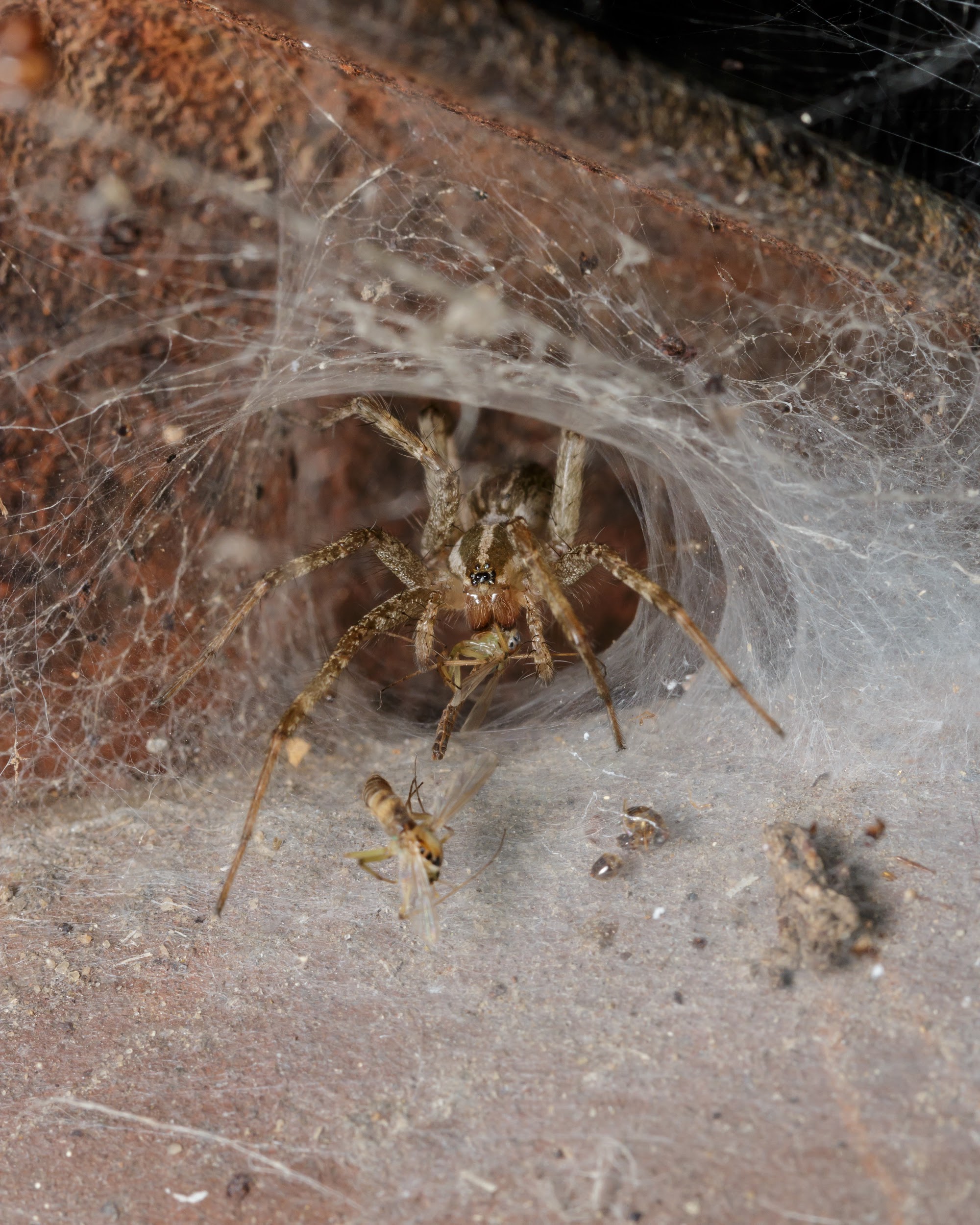
A funnel weaver spider sitting in its retreat with a midge for dinner. Photo by Meghan Cassidy.
Other spiders conserve their energy and do not build a web at all, but rely on camouflage to capture prey, such as with the crab spiders in the family Thomisidae. The flower crab spiders are beautifully colored and will often be nearly identical in color as the flower they will sit on. They blend in so well that incoming insects are caught totally unaware and end up as dinner. These spiders came by their name from their appearance:their first two pairs of legs are much longer than their last two pairs of legs, giving them an appearance similar to a crab.. Crab spiders sit with those four long legs wide open while waiting for prey.
In addition to the brightly colored flower crab spiders, there are also ground crab spiders (Xysticus spp.) and bark crab spiders (Bassaniana spp.) that instead of being brightly colored, are brown with varying patterns and speckling. Their coloration allows them to blend in with their substrate in the leaf litter or on the bark of a tree.
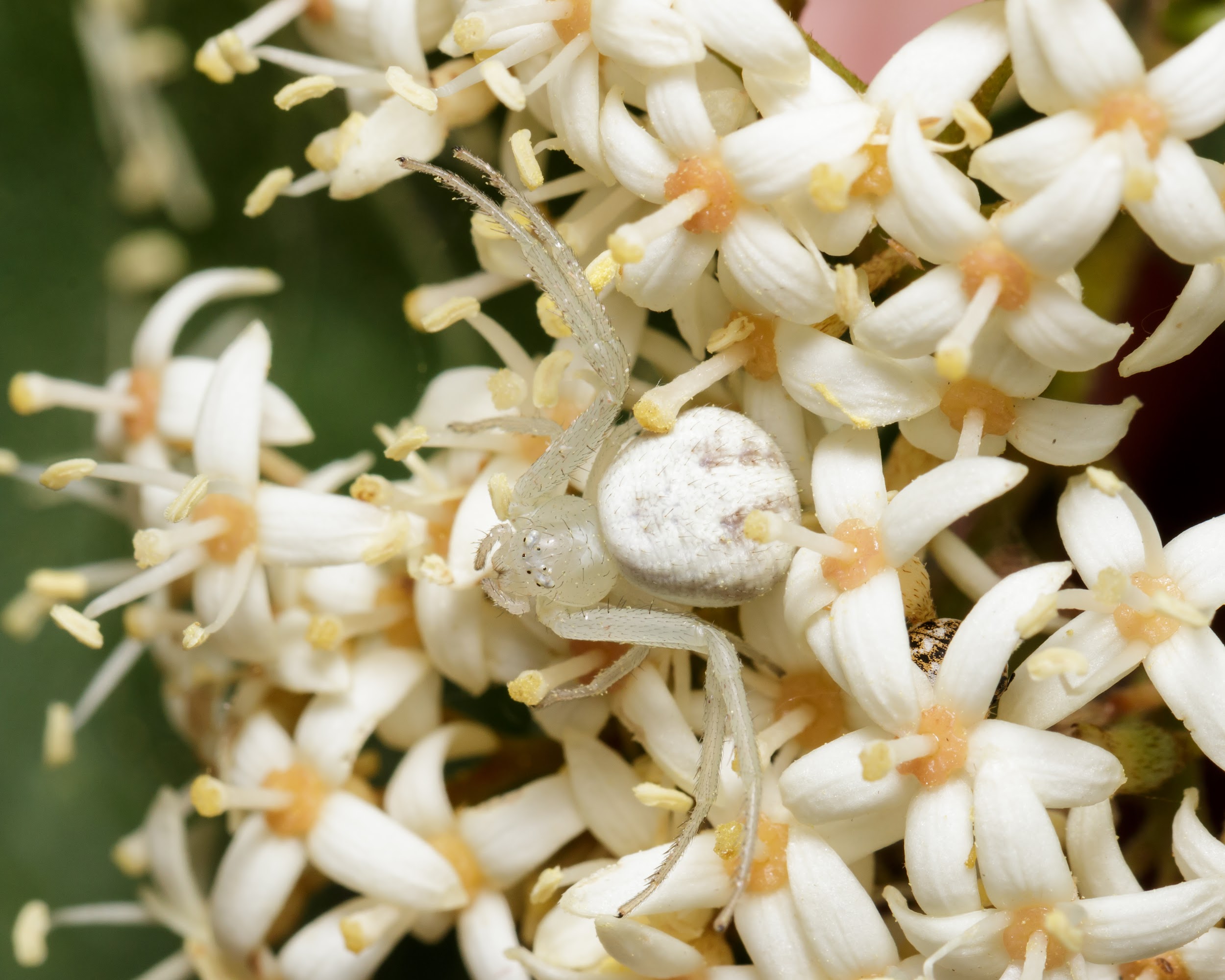
A white crab spider waiting with arms wide open for lunch to land. Photo by Meghan Cassidy.
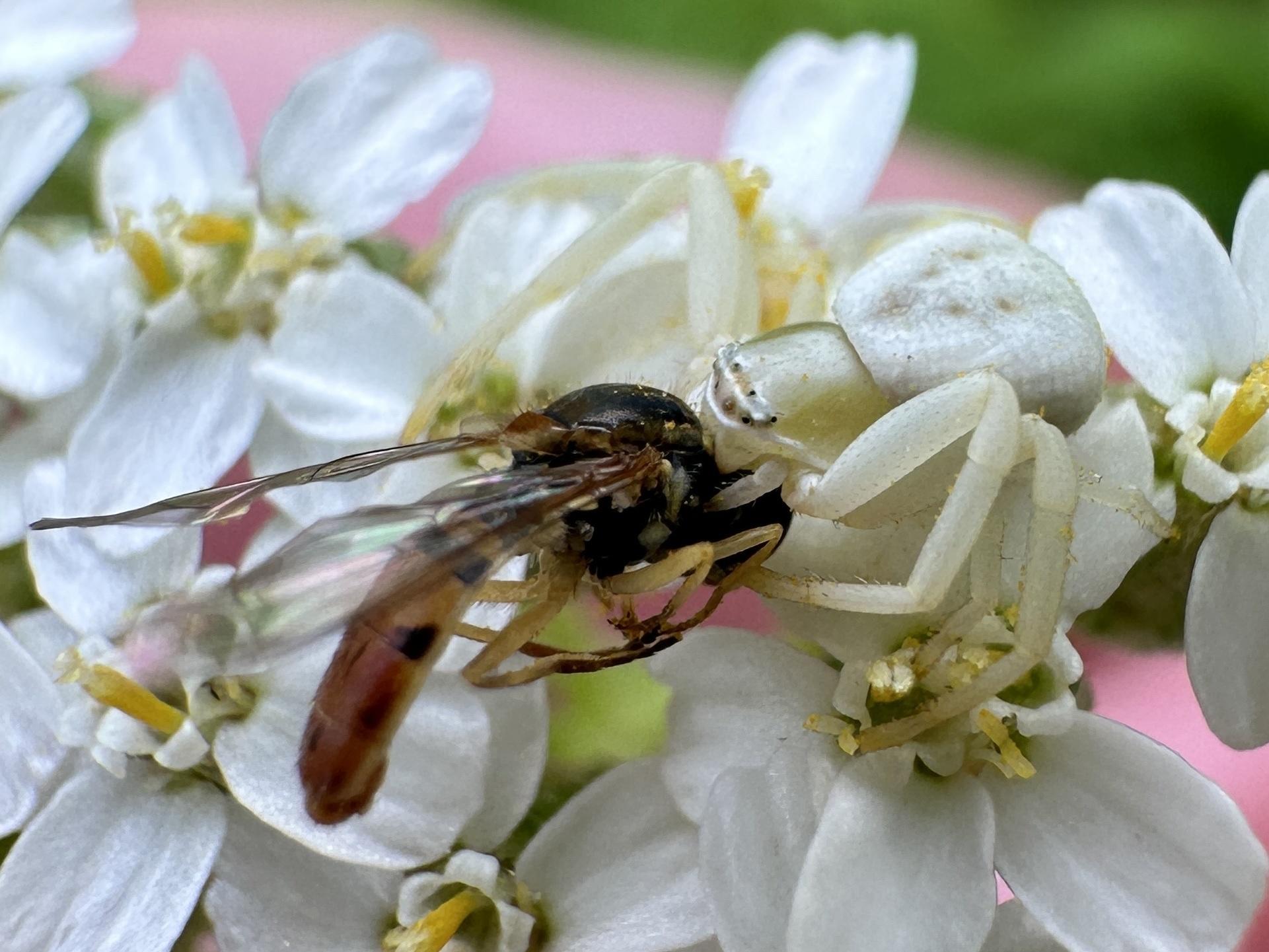
A white-banded crab spider (Misumenoides formosipes) with syrphid fly prey. Photo by Meghan Cassidy.
There are also spiders that are active predators, kind of like tiny cheetahs, who search, stalk and leap onto their prey, such as the jumping spiders in family Salticidae. These curious little spiders have fantastic eyesight and are able to track movement very well for an invertebrate. While their eyesight is fantastic, it is much more effective in the daytime compared to at night, when available light is at a minimum. While these spiders do not spin webs for hunting, they will use their silk to create a silken retreat and use it to sleep in once the sun goes down.
These spiders are also quite cute! So much so that cartoons have been made of these adorable little spiders, such as the internet famous Lucas the Spider created by animator Joshua Slice.
There are over 60 species of jumping spiders across Minnesota, and they vary widely in shape and color, but one of the largest and most visible is the bold jumping spider (Phidippus audax). You may see one of these black and white spiders around your home or while out on a walk at a local park!
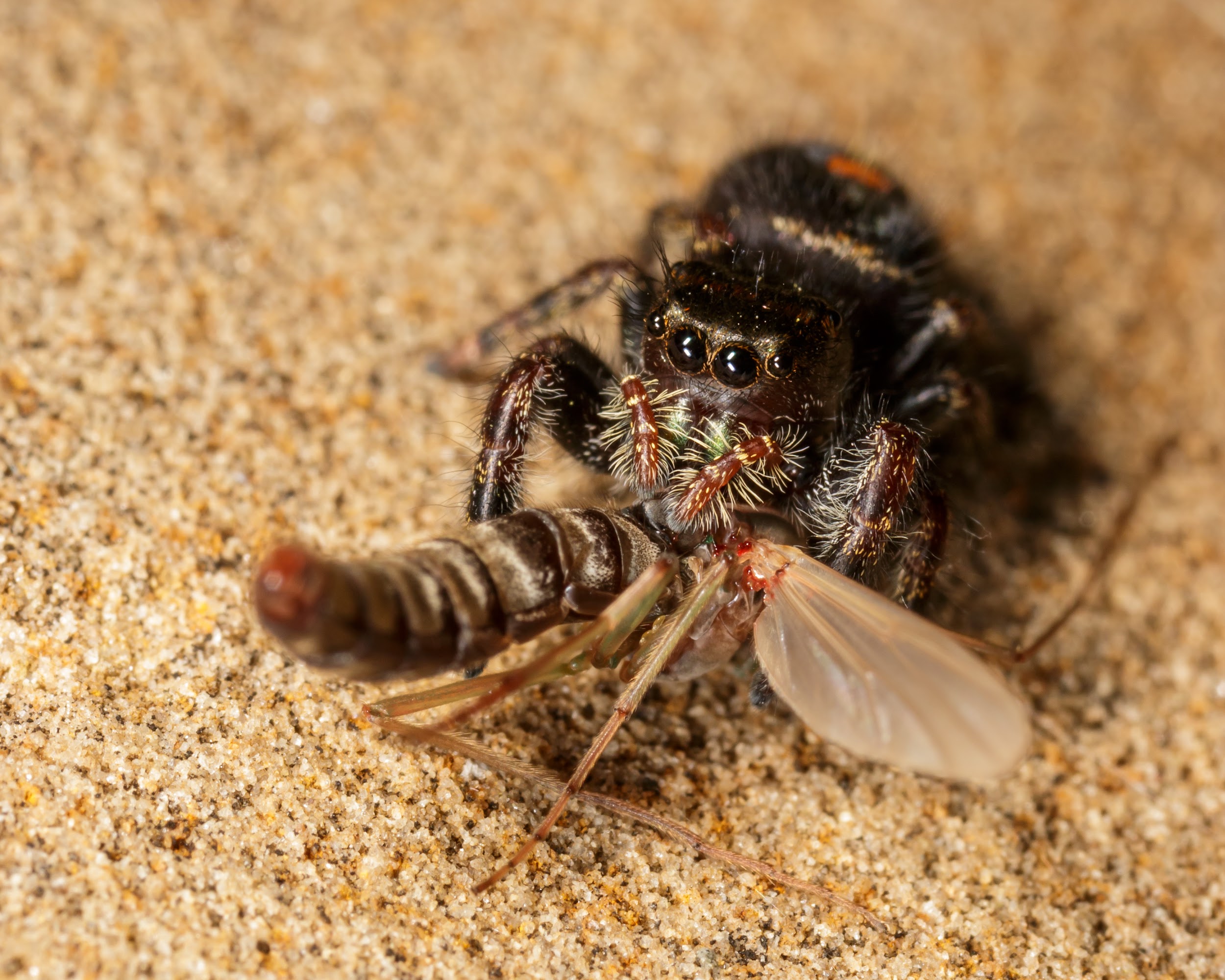
A juvenile bold jumping spider (Phidippus audax) proudly eating a midge for lunch. Photo by Meghan Cassidy.
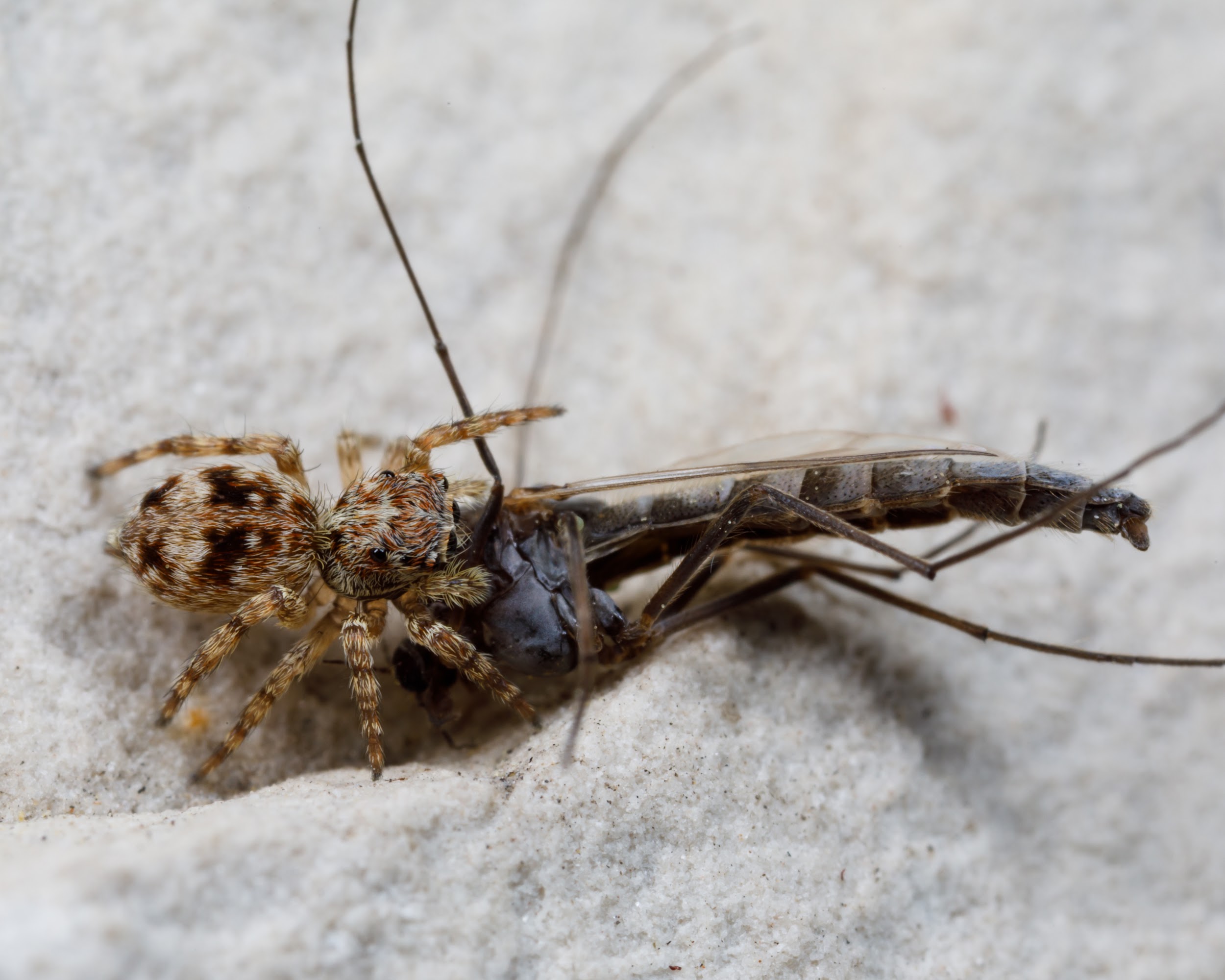
A small Attulus fasciger jumping spider with a large midge for dinner. Photo by Meghan Cassidy.
What about their bites?
In action movies like Spider-Man, we see a spider immediately bite Peter Parker and turn him into something more than human. In reality, spider bites are incredibly rare and will certainly not turn you into a superhuman with fantastical powers.
There are only two types of spiders in the United States that are considered dangerous to humans. Those are the brown recluses (Loxosceles sp.) and the black widow spiders (Latrodectus sp.). While brown recluses do not range in Minnesota, there have been a couple reports where humans have unintentionally brought them in from out of state.
It is possible we have black widow spiders that range in Minnesota, but you are only going to find them if you are very lucky and looking in the far southeast corner of the state. Black widow spiders are in the cobweb spider family, Theridiidae. Cobweb spiders build very messy, chaotic webs often in dark crevices and cracks, such as in tree hollows and sometimes in sheds, if prey is available. These spiders are often the most easily identified by their red hourglass pattern that appears on the underside of the spider.
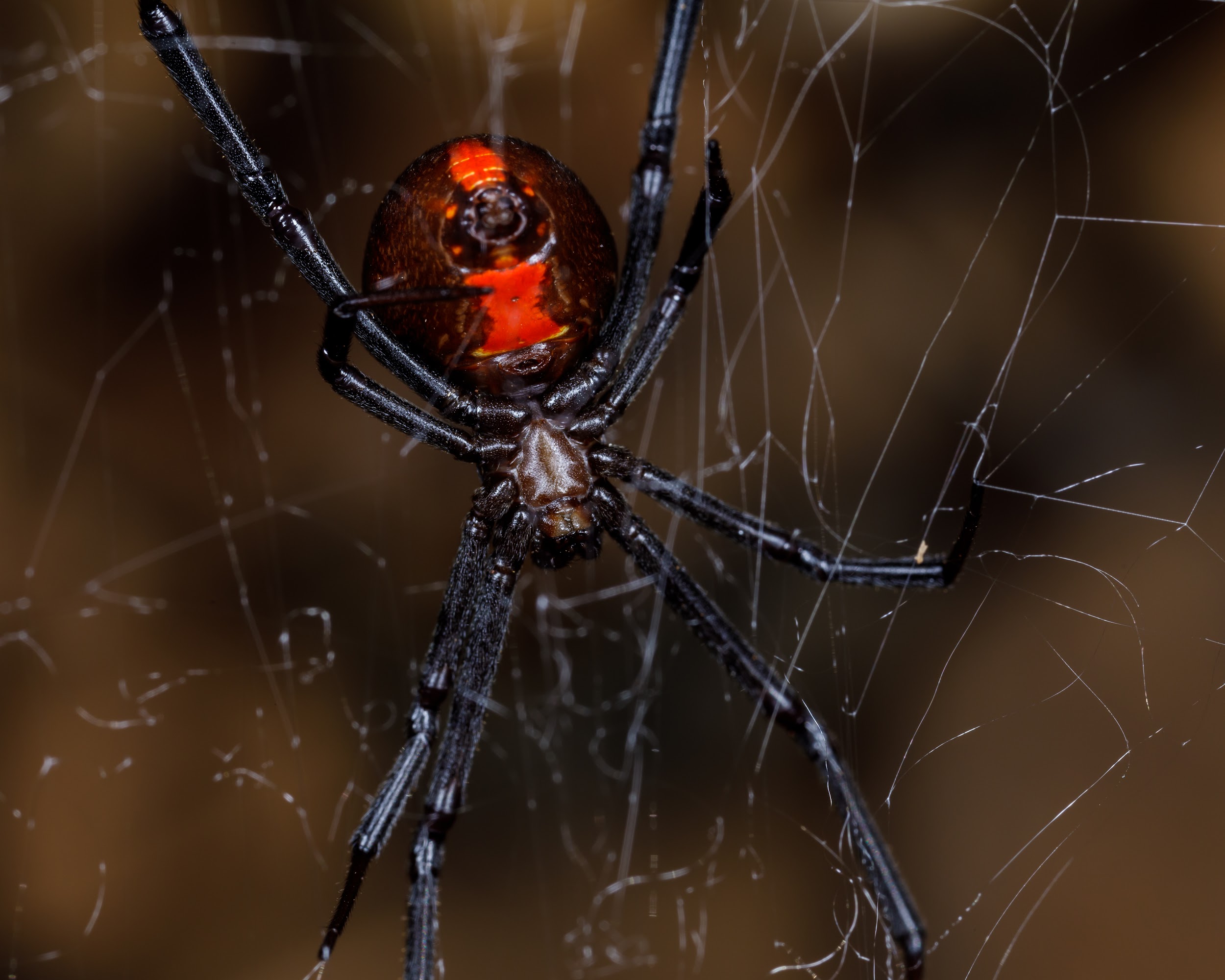
A female black widow (Latrodectus sp.) from Mills County, Texas. Photo by Meghan Cassidy.
Most spiders you will encounter in your day-to-day life in the Twin Cities, whether inside your home or outside, are only a threat to other invertebrates, like insects and occasionally other spiders (yes, sometimes spiders will eat each other). The vast majority of spiders around us produce venom as that is how they subdue and digest their prey, but that does not necessarily mean they are dangerous to us. There is also a very interesting family of spiders, Uloboridae, that do not produce venom at all.
Most spiders you will encounter in Minnesota are not considered medically significant, though if you ever have a concern and think you have been bitten by something significant, whether that be a spider, insect, or otherwise, it is always best to seek medical advice from a licensed medical professional.
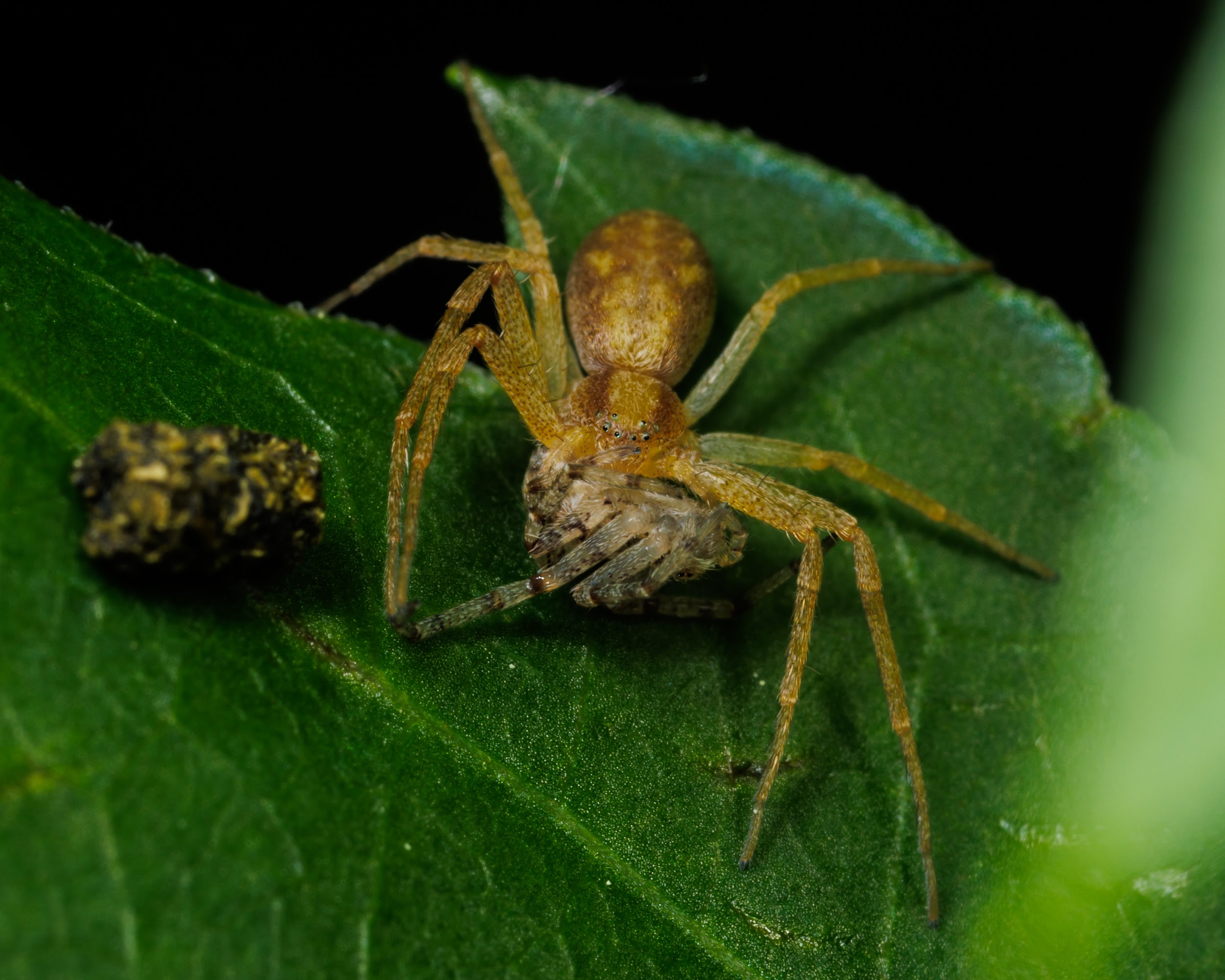
A running crab spider (family Philodromidae) eating another spider. Photo by Meghan Cassidy.
Undoing the web of lies
Despite the spookiness of the season, and the spin of many movies and news articles, I hope that next time you encounter a spider you will remember that they are far from terrifying. Spiders are ecologically beneficial animals that are great to have around, and some species are capable of complex social bonds and can even solve simple puzzles. Like other animals we share the planet with, spiders are more interesting and complicated than they seem and how they are portrayed. I always remember this as I fold my laundry in the basement of our home, glancing up at the little funnel weaver in her sheet web in my window, keeping me company. I have learned to appreciate their quiet presence that lets me know they are on duty to keep our home pest free. I hope this spooky season, you can also find new reasons for fascination and appreciation for the spiders around you!
Want to learn more about these interesting animals we share our world with? Check out these other interesting articles:
The Myths and Facts of Spiders | Three Rivers Park District
6 Common Myths About Spiders | Right as Rain How to Identify and Misidentify a Brown Recluse Spider
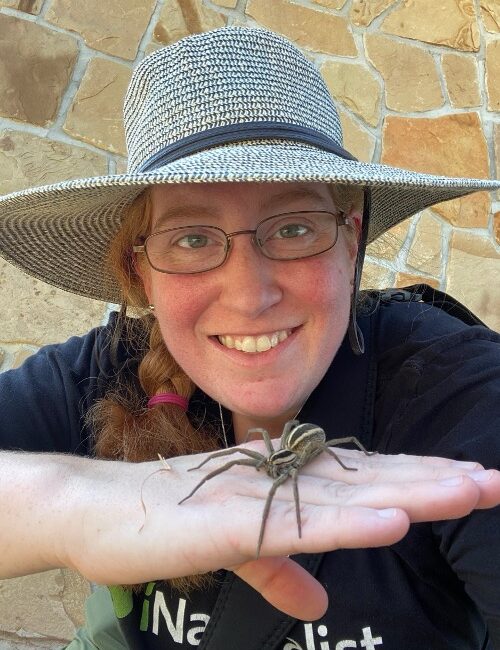
Meghan Cassidy with Rabid Wolf Spider friend. Photo by Meghan Cassidy
A previous version of this story misidentified a white crab spider as Misumenoides formosipes, or a whitebanded crab spider. The current version reflects correct changes made.