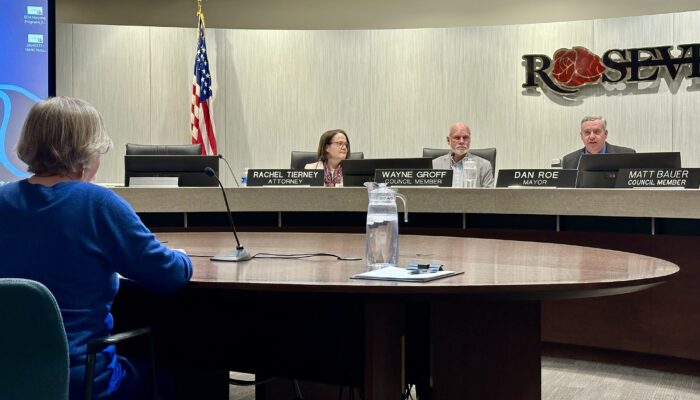
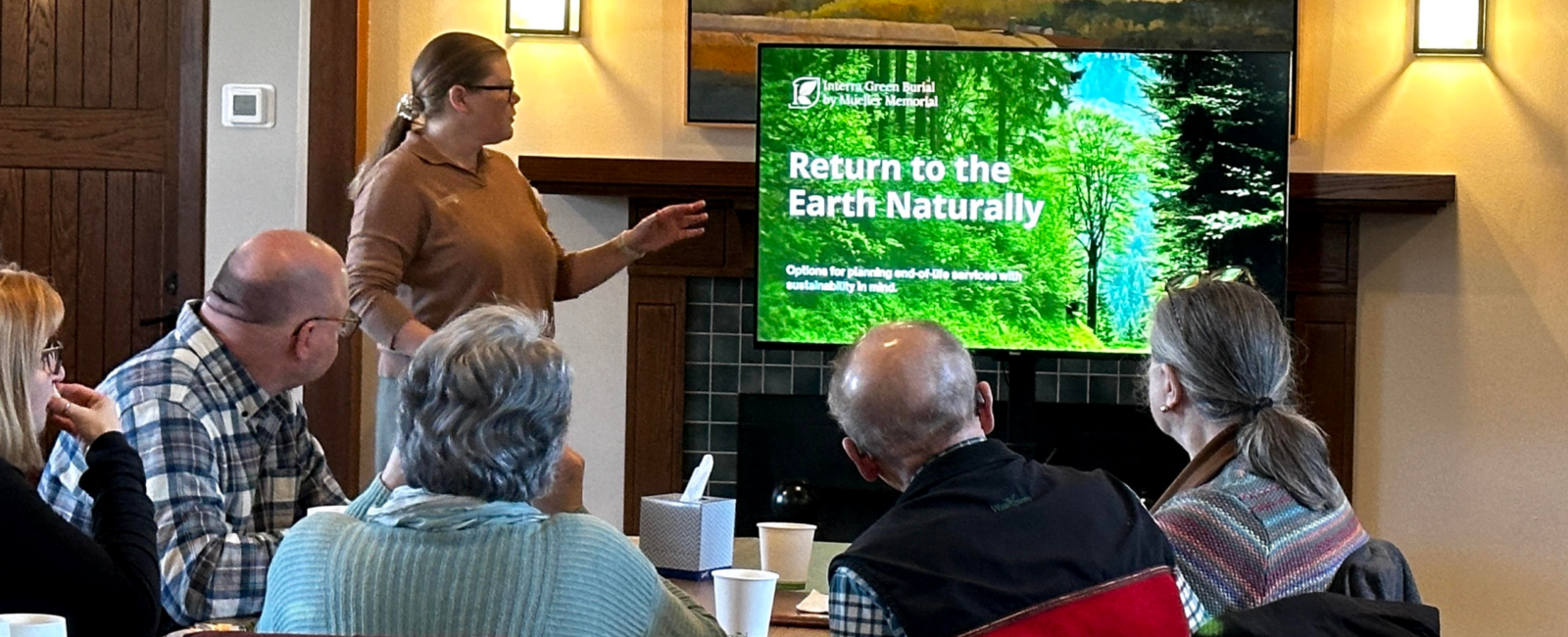
Taelor Johnson of Interra Green Burial presents environmentally-friendly burial options to attendees at Roselawn Chapel on Saturday, Jan. 31. Photo by Meghan Cassidy.
Interra Green Burial and Roselawn Cemetery shared a variety of ways people can be given back to the Earth.
By Carly Aulicky – Volunteer contributor, Resilient Roseville
“Leave the world better than you found it” is an ethos that many people hold close to their hearts. It’s a sentiment that guides the daily decisions of countless people and their aspirations for their time on Earth. Some Roseville residents have begun to ask if it could be possible to do so in death as well.
An information session on Jan. 31, “Green to the End,” drew 25 people to the chapel at Roselawn Cemetery. The session, sponsored by local sustainability group Resilient Roseville, featured Interra Green Burial by Mueller Memorial, one of two funeral service providers in Minnesota certified to provide green burial options by the Green Burial Council. Interra has been actively involved in advocating for green burial options for Minnesotans since 2020.
Attendees learned not only about ways to have a low or even net-positive ecological impact after death, but also about those who paved the way for Minnesotans to access these options.
Returning to the earth
The presentation by Taelor Johnson, communications director at Interra, covered three main types of green burial options: natural organic reduction (NOR) or body composting, green or natural burials and aquamation.
Despite the heaviness of discussing final arrangements, Johnson’s presentation was lively, upbeat and affirming of how great it is that Minnesotans are able to carry out their final wishes in ecologically responsible ways.
Roselawn Cemetery Executive Director Amanda Thoresen also spoke about how plots and memoriams can accommodate green services. Roselawn is a nonprofit cemetery that has been providing final resting places since 1902. Today, it has begun to offer an extensive line of green options for a final resting place.
The desire to have a positive impact even in death was a core value of Steve Wheeler, a teacher whose final wishes as he battled cancer in 2023 were to be able to give something back. His research led him to discover one of many green burial rites— body composting or natural organic reduction (NOR).
NOR is a process that allows the body to undergo natural decomposition in a controlled compositing container. Over the course of 60-90 days, a person’s remains become up to 250 pounds of organic compost. The resulting nutrient-rich material is then given to loved ones for personal use or can be placed in a burial site or dedicated green space.
At the time of Mr. Wheeler’s end-of-life planning, NOR was not an option for him in Minnesota. His story influenced the advocacy done by Mueller Memorial and other grassroots activists in the movement to legalize NOR in Minnesota in the 2023-2024 legislative session.
While Mr. Wheeler unfortunately did not live to see NOR be legalized in Minnesota, he was able to complete his final wishes of NOR in Colorado. His story later helped NOR become an option to other Minnesotans as of May 24, 2024.
At this time, there are no dedicated NOR facilities in Minnesota, but providers such as Return Home are planning to open a facility within our state as soon as 2027, making this a more accessible option to those seeking alternatives to traditional burial rites.
Green burials and aquamation go back to basics
NOR was only one of three green burial options discussed as being available to Roseville residents. Green burial services offer direct low ecological impact alternatives to traditional burial and cremation options.
Green burials minimize environmental impacts of the burial process by not embalming the body, dressing the departed only in natural materials that will decompose and using a biodegradable casket or carrier to bury the body directly into the earth. This process, according to Johnson and Thoreson, goes back to the basics of funeral rites, mirroring those used by countless cultures and peoples across the world and time.
Aquamation, also known as water cremation or alkaline hydrolysis, is a water-based alternative to cremation that uses a lye solution and heat to reduce the soft tissue and leave behind a fine powder similar to cremation ash.
The aquamation process only uses about a household’s amount of water and the sterile solution is able to be processed through waste water treatment, allowing a return to nature through the water cycle as well as producing physical remains that can be returned to loved ones, memorialized or scattered.
Currently, Roselawn Cemetery is able to provide green burial services, including hybrid options where someone who wishes to have green burial rites can be buried next to a loved one who wishes for traditional burial services within the same family plot. They also offer an extensive set of options for memorial sites of ash remains or remains from the aquamation process, including columbaria, or public storage of urns, and the ability to bury up to two ash remains above a buried casket.
Roselawn plans restored prairie for green burials
The non-profit cemetery also has bigger and greener plans for future final resting place options—Roselawn is currently working on the design of a green burial certified designated area on cemetery grounds. Design of this space is underway with landscape architects with a vision of a low carbon impact and the greatest contribution towards ecological benefit.
Above ground, the green burial space will be planted with native prairie species to provide habitat and benefit to pollinators such as monarch butterflies. Within it, there will be room for 3,000 mounded burial sites that will allow for natural burial without synthetic materials and embalming chemicals, NOR and aquamated remains only. This area, Amanda Thoreson said, will be managed as a native prairie restoration to provide the greatest ecological impact for those that chose a green burial option.
If you are a Roseville resident interested in a green burial option for your final rites, Interra and Roselawn both recommend planning ahead. Just like with traditional burial and cremation options, having a written plan helps to ensure that your wishes are carried out and prevents added stress for your loved ones at the time of passing.
If green burial options sound appealing to you, both presenters recommended working with a funeral service provider and cemetery now. A funeral service provider and cemetery will be able to walk you through all the options open to you, costs and ensure that a plan is put in place to carry out the service and memorial that you would like.