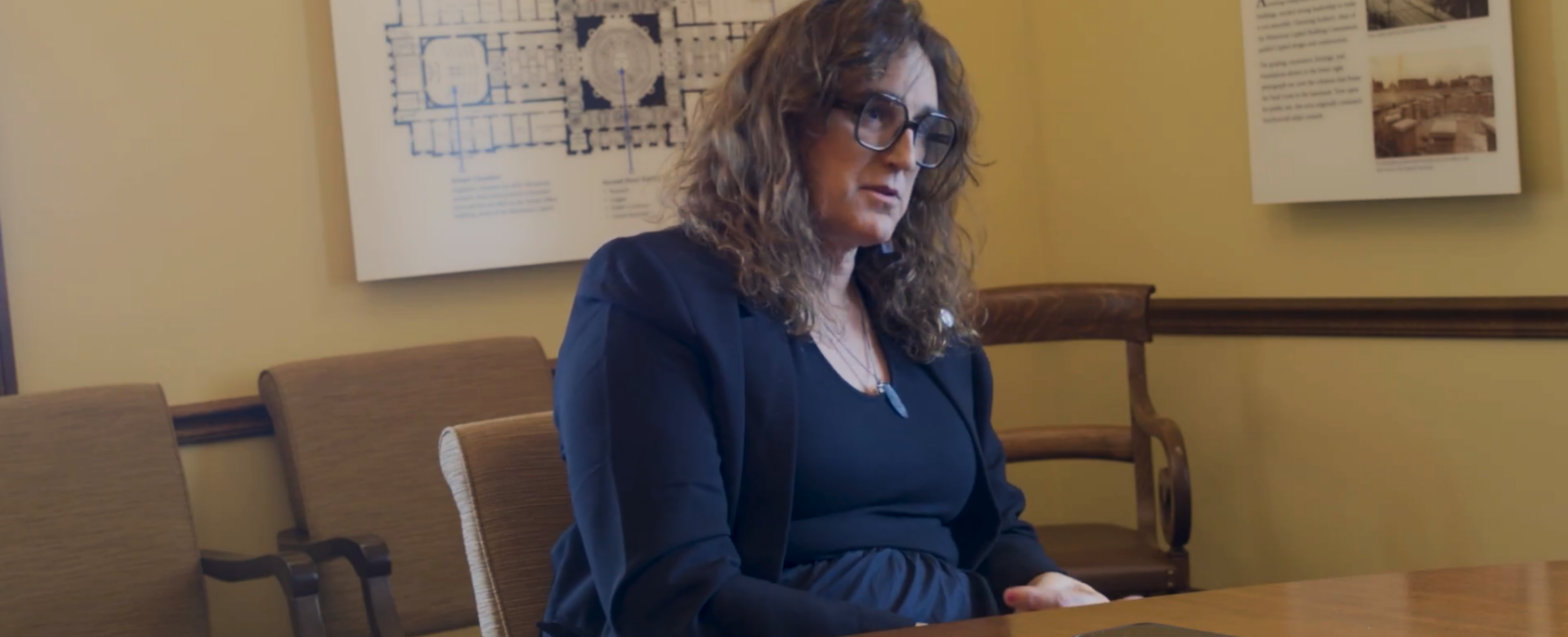
Rep. Finke, who represents Roseville and surrounding communities in District 66A, spoke to the Roseville Reporter about this past session, her goals for the next and navigating the country’s political climate
By Sommer Wagen and Max Jasper
Rep. Leigh Finke (DFL-St. Paul) represents District 66A in the Minnesota House of Representatives, including the communities of Roseville, Falcon Heights and Lauderdale. Her slogan for her reelection campaign this year: “Get some rest. Go dancing. Keep fighting.”
After a legislative session that started at the height of Operation Metro Surge and ended with another standstill on gun violence prevention, all happening within the context of an increasingly hostile federal government, Rep. Finke took time to reflect with the Roseville Reporter and shared what keeps her fighting for people’s rights.
Continue reading for the interview or watch it in video form below.
Answers have been edited for clarity.
What would you say were the highlights of this past session?
We did some really good work on housing. I think that is the biggest success— that we were able to achieve in the tie in the House.
Representative Liish Kozlowski (DFL-Duluth) had a bill to provide $40 million in rental assistance. Some of that money will go directly to those affected by the ICE occupation. That’s a major success, and I’m really proud of it.
But, yeah, I mean, highlights are few and far between. We worked well together, we didn’t have any major blowups at the end of the session and we were able to do some good work to protect consumers and address affordability and fraud. So, yeah, it was a moderately good end of the session.
On the other hand, what would you say were the biggest challenges?
The most difficult thing that we confronted this year was the fact of the Trump administration cuts to Medicare, Medicaid and an unwilling partnership from Minnesota Republicans to try to offset that in any way. I mean, there’s nothing we can do to stop a billion dollars in cuts to our most vulnerable, but there are things we can do to lessen the impacts on affordability, gas prices, groceries, health care. We could have done something and we weren’t able to because we need bipartisan support for all movements and we didn’t have it.
I would say that’s the most far-reaching disappointment to me, but the most emotional disappointment is that we were not able to move the gun violence package. I was one of the people who organized the sit-in at the end of session to try to pressure Speaker [Lisa] Demuth (R-Cold Spring) to take a vote on the gun violence prevention package that was passed by the Senate, and she refused, and that’s incredibly disappointing.
Not to mention, at the beginning of the year, Operation Metro Surge came to the Twin Cities. Can you kind of paint a picture of what being at work as a legislator was like in that time and what the challenges were with that?
Metro Surge shaped everything that happened during and after it. You know, we had a community member, a member of the queer community [Renee Good] was murdered by the government and Alex Pretti as well. More than 3,000 people were arrested, detained and deported. I have described that as a terror campaign, which I think it really is. The intention is not just a deportation campaign, which it is, but it’s also to create fear in everyone— submissive fear to the federal government.
But before the legislative session during Metro Surge, it was just a constant need, community need, people reaching out. “I can’t find my brother. I can’t find my parents. I think they were taken. How do we find them?” A lot of coordinating, a lot of action. Then when we got back into session, it was making sure there’s some accountability, at least in the messaging that we have, because we know we can get the votes.
We tried to legislate. I brought two bills to address secret police tactics, but they didn’t move because we need Republican support. A lot of Republicans think that not only is this okay, but that it was good and we need more of this kind of terror. We did eventually hear a few members of the Republican Party sort of distance themselves from what was happening.
We did what we had to do. We moved what we could and we’ll come back with the majority next year and finish it up.
What’s your approach to kind of reaching across the aisle and appealing to the other side?
I have no problem working across the aisle, but the difficulty is that there is not a lot of interest in working with me. I don’t get a lot of the basic respect that lawmakers receive, and I’m convinced the only reason is because I am transgender. They can’t even use my pronouns or my name, so there’s not a lot of goodwill to sit down and collaborate on legislation, which is a shame because I share a lot of concerns with many members of the Republican Party especially around surveillance and privacy and concerns about big tech. And we did good work on fraud, for example, and created the Office of Inspector General for Fraud in Minnesota. And that was a bill that was entirely bipartisan. I may not have been the lead author on that, but I’m very supportive in doing my part in the project, trying to create good governance. We all have our part to play.
Minnesota is a trans sanctuary state and is generally welcoming of LGBTQ+ folks. Still, it’s hard to see attacks against trans people in other states and on the federal level. How do you approach this issue as a state representative as well as with your perspective as a trans person?
We’re in a very difficult time. There is a national campaign to remove our health care and to remove our legal protections and legal identities— basically, eradication from public life is what you hear. And we’ve done a lot of good work in Minnesota. We have the highest percentage of trans adults in America. We are really establishing ourselves as a leader, but nowhere is perfectly safe, of course. We have the laws, but the laws don’t change culture, right? The laws don’t change people’s hearts, and that’s really what we need to do.
Minnesota has done a really nice job, but watching what’s happening around the country, especially this latest move, the instant invalidation of all driver’s licenses of transgender people, that we’re seeing. We’ve seen that in a few states now. That’s really scary. That’s a really frightening power to be able to say you have no legal document that is usable, just like that. I think that’s the direction we’ll continue to move as long as [Trump] is in the White House.
As a representative who is a trans woman, it makes my commitment to the work that much greater. I could never leave knowing the vacuum that that would create in leadership in Minnesota, even beyond, because I’ve been very lucky in my ability to represent the community. But it also raises my profile and it makes that work all the more difficult. There are costs to doing this work as a public transgender person. But I couldn’t leave and I don’t want to. I love my job; I love representing trans people more than anything.
Do you have any thoughts on efforts to revive local news?
I think it’s incredibly important, not just that we have local papers, but that those local papers are independently and locally owned.
One of the biggest, most important tools of a fascist society is controlling media. And you have these massive media companies that own all the little papers. So even if you have a little paper, it may not be independently owned. It may be owned by the people who are pushing a message.
Our values should be to support newspapers— local people having local opinions printed and read by the people around them and reporters and not just opinions, but local reportage as well.
Minnesota was able to ban cryptocurrency kiosks this session, which is significant considering Roseville’s large elderly population, who are seen as the most vulnerable to these scams. Do you have any thoughts on that?
I was in the Commerce Committee where we heard about cryptocurrency machines. The thing about these machines is that people don’t know what exactly they do. If you put money into a box, you should know what’s happening with it and you should know how to access it.
People have worked hard for the money that they have, especially our aging community where it’s harder and harder for folks to continue to live well financially. Anything that we can do to protect people is worthwhile.
If you are interested in investing in crypto, there are many, many ways to do that that require at least some barrier to entry. And I believe there should be some barriers to entry. You shouldn’t just be able to walk up to what you think might be an ATM and put money into it and not have it come back and then not know what happened.
Do you have any goals in mind for the next session?
I have big goals for next session. First and foremost is passing the Equal Rights Amendment. We’ve been waiting for 40 years to pass Minnesota’s Equal Rights Amendment and it’s time.
I would like to see, as I mentioned, the gun violence prevention package. I would like to see a response to federal administrative punitive cuts that have been made to Minnesota. We need to do what we can to backfill on Medicaid, Medicare and take care of our neighbors with disabilities who are going to be tremendously hurt by what’s happening.
I also want to ban solitary confinement in our prisons, and ban it for real. We kind of did a halfway thing about 10 years ago, but I’d like to see it put to an end. And I’d like to see some greater protections for vulnerable young people, including trans people. We did good work, but the anti-trans movement has advanced in the ways that they’re taking away our rights, and we need to continue to stay at pace.
How can your constituents become more involved with local politics and your efforts in particular?
If folks want to get involved in our work, you can go to leighformn.com and volunteer. We’re getting our campaign moving here. By the end of June, we’ll be up, we’ll be door knocking. There’s lots to do.
But more importantly, you know, if you want to stay involved, read the paper, read your local paper. And follow the real news, on the ground. Talk to people. Get to know your candidates. Don’t just follow social media. Get involved in a campaign that you care about and stay in it.