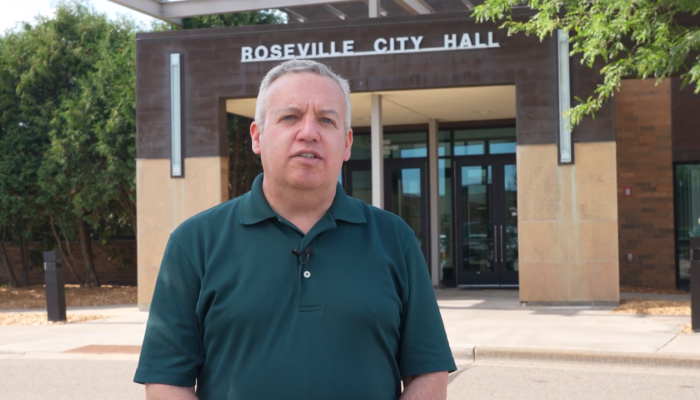


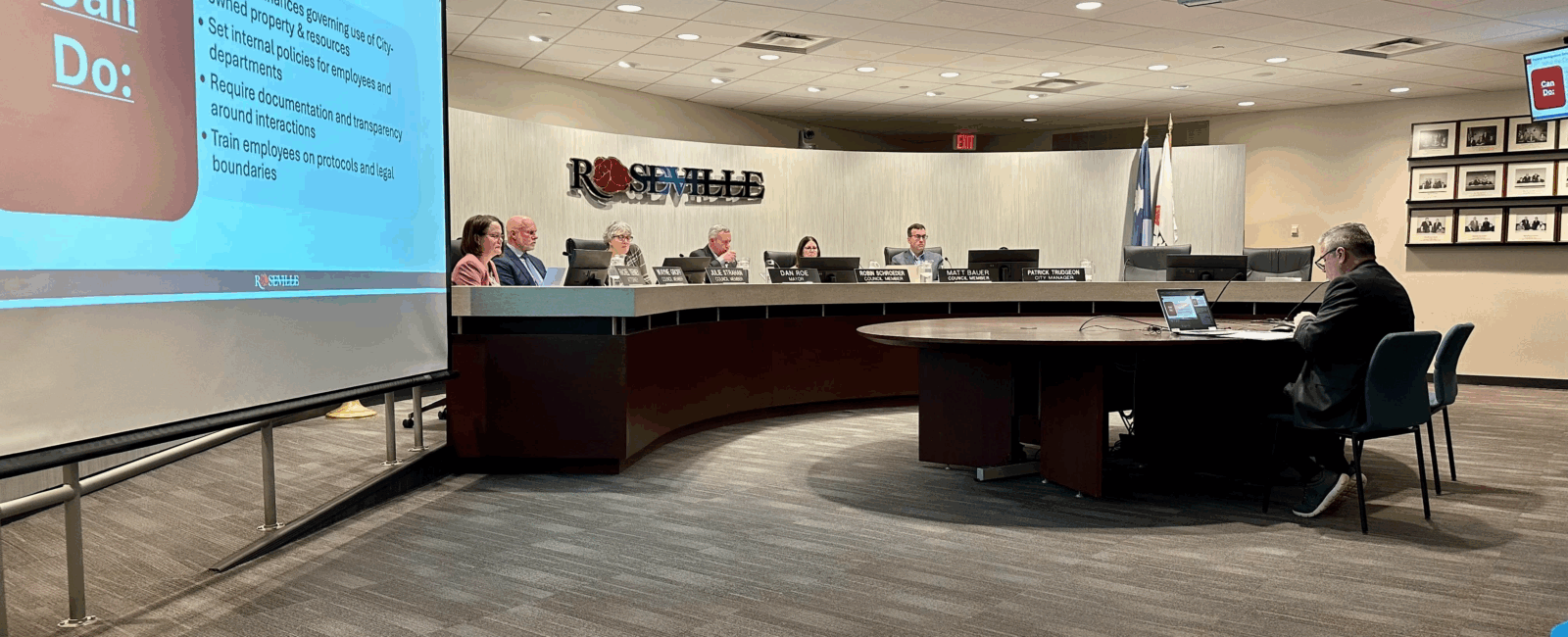
Roseville City Manager Pat Trudgeon presents what Roseville can and can’t do in response to federal immigration enforcement, noting alongside approved ordinances that federal authority supersedes the city’s. Photo by Max Jasper | The Roseville Reporter.
The City Council approved a new ordinance Thursday limiting city involvement in federal immigration enforcement amid community outrage.
by Max Jasper — Community reporter
After weeks of escalating fear, late night raids and hundreds of residents mobilizing across the city, the Roseville City Council approved a new ordinance on Thursday restricting how city property, staff time and data can be used in federal immigration enforcement.
City leaders described the move as both necessary and limited in its power.
The vote came during a tense, hours-long Jan. 22 meeting where residents again packed City Hall to demand stronger action in response to Operation Metro Surge, a federal immigration crackdown that has brought thousands of DHS, ICE and CBP agents into Minnesota.
“ICE is harming people and we want them to leave Roseville,” Mayor Dan Roe said. “There is no question about that.”
‘I am terrified’
The meeting followed a Jan. 12 public hearing that drew more than 300 people and nearly four hours of testimony describing masked federal agents, unmarked vehicles, racial profiling and residents including U.S. citizens detained or questioned without cause.
Parents, teachers and neighbors told the council they have been organizing their own rapid response networks, standing outside schools and daycares in reflective vests and documenting federal activity in parking lots and apartment complexes.
Angela Byrne, a local educator and 15-year Roseville resident, told the council that the fear has become overwhelming.
“There are people in high-vis vests and whistles literally standing between your constituents and being disappeared,” she said. “My students cannot leave their homes. They can barely open the door to get groceries.”
Another resident, Mimi Amelang, said ICE agents had repeatedly driven past her child’s daycare.
“I am terrified that these armed and completely untrained people are anywhere near my small child,” she said.
‘In the dark, just like everybody else’
City Manager Patrick Trudgeon delivered a detailed presentation outlining what the city has done since Jan. 12 and what it legally cannot do. He acknowledged the community’s anger and fear but emphasized the limits of local authority.
“Federal law and authority supersede the power of cities,” Trudgeon said. “We are really struggling to find a way to make a meaningful impact on what is happening out there.”
Trudgeon said Roseville police are not notified of ICE operations, leaving the city “in the dark, just like everybody else.” He warned that confronting federal agents directly would be unsafe and likely escalate tensions.
Still, he outlined several steps the city has taken, including updating police policies, strengthening rules requiring officers to remain identifiable, restricting data sharing, posting signs at city parking lots, training employees and creating an email address for residents to report federal activity on city property.
The newly approved “Use of City Resources Ordinance,” Ordinance 1698, codifies many of those practices. It prohibits city staff, equipment, facilities and data from being used to support federal immigration enforcement unless required by law. It also bars federal agencies from using city-owned parking lots or nonpublic spaces as staging areas. City employees must report any interaction with DHS or ICE to the city manager.
A companion resolution also approved Thursday outlines the council’s rationale, citing community trust and public safety as well as testimony describing tactics “inconsistent with best law enforcement practices and the U.S. Constitution.”
“Ice is harming people and we want them to leave Roseville. There is no question about that.” — Roseville Mayor Dan Roe
Residents call for greater action
During the final discussion, council members emphasized that the ordinance is only a first step. Councilmember Wayne Groff said that government “does not move quickly” and that the city will need to do more.
Councilmember Robin Schroeder called the ordinance a “living document” that will likely require amendments as the situation evolves.
The council also confronted immediate questions about enforcement. Councilmember Julie Strahan asked whether ICE agents could actually be cited for violating the ordinance by using city property. Staff acknowledged that while violations are technically subject to administrative citation, the city has no practical way to identify or serve ICE personnel. Trudgeon said the city may need to “figure something out,” but enforcement remains uncertain.
The council then turned to Police Policy 413, which governs how officers interact with federal immigration officials. Instead of approving the updated policy, the council voted unanimously to send it back for revisions. Several members objected to language authorizing officers to assist in ensuring “the safety of federal immigration employees,” saying it conflicted with the city’s stated goals.
Many residents said the city’s actions still fall short.
Eric S., who lives near a site where ICE agents were seen staging before dawn, criticized the city’s limited response.
“If I called about teenagers drinking in a parking lot, cops would be there in 15 seconds,” he said. “But when armed federal agents are there, you say there is nothing you can do.”
Others urged the council to take greater risks.
“This is a moral moment,” Amelang said. “You have more power than me. What I have seen tonight has largely amounted to: ‘There is nothing we can do.’ I do not accept that.”
Councilmember Julie Strahan responded emotionally to criticism that the council was not doing enough.
“We are your neighbors. We care as much as you do. We are not your enemies,” she said. “We want ICE to get the hell out of our town. But we cannot break the law because someone else is breaking the law.”
Mayor Roe echoed that sentiment, saying the city must balance community demands with legal constraints and ongoing emergency calls unrelated to immigration enforcement.
“Our police still have to respond to medical emergencies, domestic violence, burglaries,” he said. “The question is whether they can also be doing additional things too.”
Moving forward with risks in mind
Trudgeon warned that the ordinance could carry financial risks. Roseville recently received $4.5 million in federal funding to expand police and fire staffing and additional federal support for embedded social workers.
“I am not saying that funding will be pulled,” Trudgeon said. “But we need to be clear eyed that there may be impacts.”
The council also discussed eviction protections and housing support for residents afraid to leave their homes, with plans to revisit the issue at upcoming meetings. City Attorney Rachel Tierney said Roseville is waiting for guidance from the Minnesota Attorney General’s Office on how cities can best support the state’s lawsuit against the federal government.
Mayor Roe closed the meeting with an extended reflection on trauma, community resilience and the long term harm caused by federal actions. He said the city will need to address the impacts “for years to come,” even after federal operations end.
Despite the tension, he thanked residents for their testimony.
“We appreciate hearing it because it informs our decision making,” Mayor Roe said. “ICE is harming people in our community and we want them to leave.”