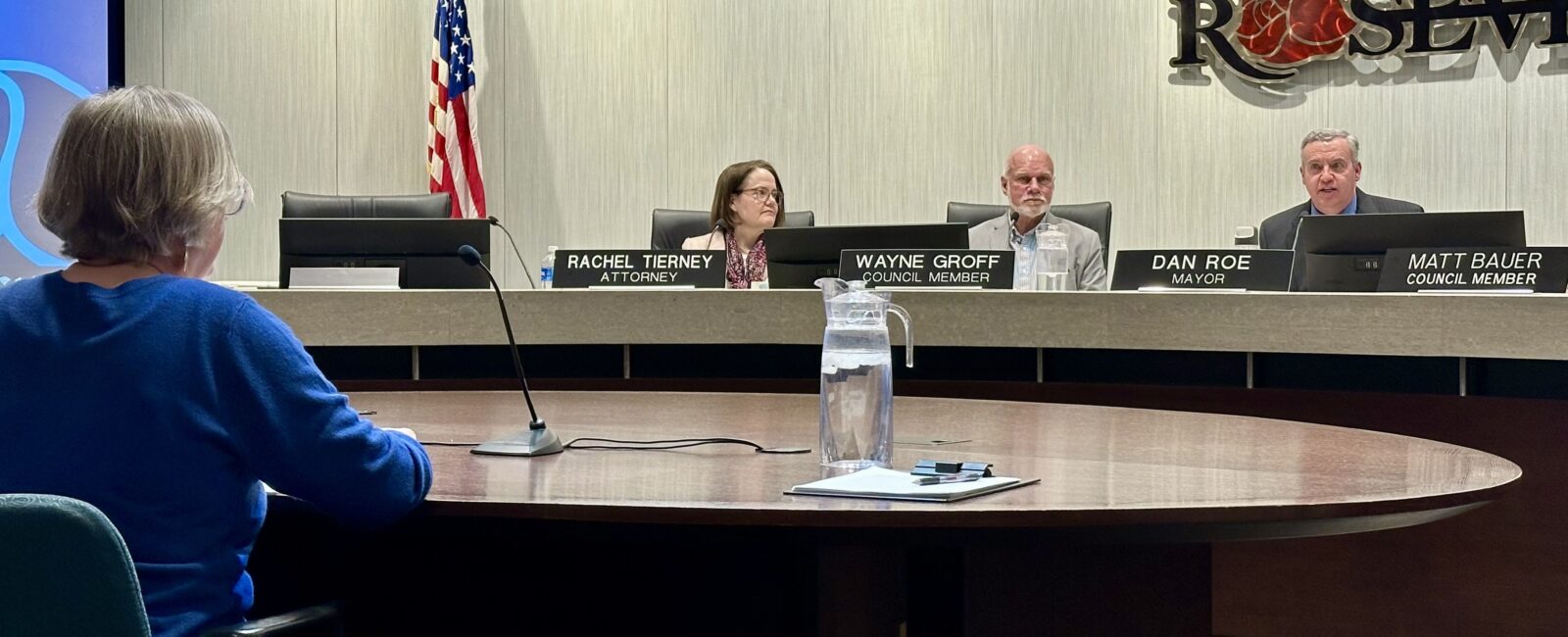
Richfield, Minn. Mayor Mary Supple fields questions from the Roseville City Council about the Cities for Safe and Stable Communities Coalition. The Council would go on to join the Coalition in a unanimous vote. Photo by Max Jasper/The Roseville Reporter.
The Roseville City Council voted unanimously to partner with more than 30 Minnesota cities seeking coordinated support and community stabilization efforts in response to Operation Metro Surge.
By Max Jasper — Community Reporter
The Roseville City Council voted unanimously Monday night to join the Cities for Safe and Stable Communities Coalition, a growing group of Minnesota cities responding to the impacts of federal immigration enforcement under Operation Metro Surge.
Roseville now joins more than 30 cities participating in the coalition, which advocates for public safety approaches that respect constitutional rights while supporting community stability and local governance. City Manager Patrick Trudgeon noted that the coalition has expanded rapidly since its formation earlier this month.
Richfield, Minn. Mayor Mary Supple, one of the coalition’s founding members, attended the meeting to answer questions and outline the group’s purpose. She explained that the coalition has grown quickly and now represents more than 500,000 residents across Minnesota.
“We thought unified, we’d have a bigger voice, and we wanted to make sure that the voices of our residents were heard,” Supple said . She added that the coalition is intentionally nonpartisan.
Although federal officials have said Operation Metro Surge is winding down, Supple said that cities are still dealing with its effects.
“They’re saying that [Operation Metro Surge] is over, but we know that the impact is carrying on and we don’t know for sure what’s going to be happening in the future,” she said.
She added that some businesses in affected communities “have had 50 to 100% of their operating income taken away” and that cities are seeking both state and federal support to stabilize housing, business activity and community trust.
Supple also said the coalition is scheduled to meet with Gov. Tim Walz on Wednesday. Several Roseville residents urged the council to join in time to participate.
During public comment, resident Cari Gelle encouraged the council to join the coalition.
“There’s a lot of benefit that could be gained by joining the residents of Roseville’s voices with all these other cities,” she said, adding that joining immediately would ensure Roseville is part of the conversation with Gov. Walz on Wednesday.
Another resident, Andy Johnson, supported the coalition while urging the city to keep the human impact of the surge at the forefront.
“I just really would love a lot of talking about the individual people that are suffering and having their lives completely upended,” he said, noting that many residents remain afraid to leave their homes even if enforcement activity has slowed.
Council members expressed broad support for joining, citing both the coalition’s focus and the relatively low cost. The city expects to pay no more than $3,000 for its share of the coalition’s consulting contract, which runs through the end of the legislative session.
Council Member Wayne Groff said the coalition’s collective approach was key. “Many voices are heard more than just individuals and many cities joined together are going to get more attention than just one city,” he said.
Mayor Dan Roe also addressed concerns raised during public comment, saying that while business impacts are significant, they often stem from workers who “are not able to leave their home and not able to trust that it’s a safe situation.”
The motion to join passed 4-0 with council member Robin Schroeder absent. Roseville will now participate in weekly coalition meetings and coordinated advocacy efforts.
Supple said the coalition’s future beyond the legislative session is “kind of fluid,” but cities remain committed to stabilizing their communities and restoring trust.