
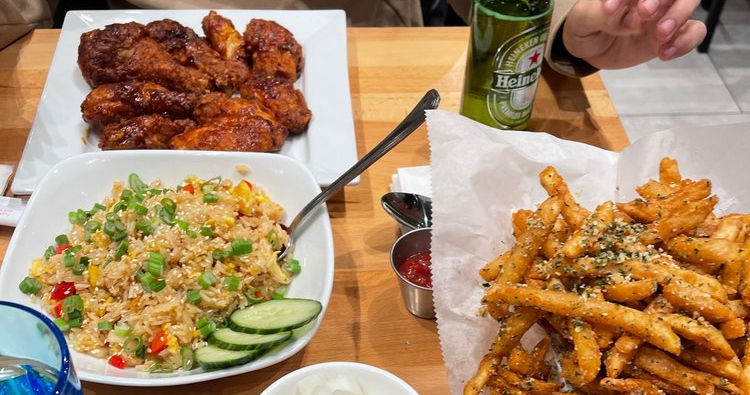
BonChon’s fried rice, five piece garlic-seasoned drumsticks, seasoned french fries and pickled radish. | Credit: Kathryn L. via Yelp
My dear departed husband had a standard retort when queried with a Quixotic question: “Ask someone who knows.”
It’s good advice for exploring different cuisines: Dine with someone who has lived it.
When my stepson Scott and his Korean-born wife Kyong visited Roseville recently, I suggested we go to BonChon, serving the food of her homeland out of a strip mall at 2191 Snelling Ave. N. She could confirm or deny authenticity.
Roseville’s BonChon location is one of five in the Twin Cities and 150 worldwide. I’d been twice before because it serves bibimbap, my favorite Korean dish. Years ago, flying Korean Air to Myanmar, bibimbap was on my tray, and it proved to be the most delicious airline food ever!
Bibimpap consists of rice (at BonChon, the rice is piled in a cauldron) with egg, various veggies, spicy sauce and protein— chicken, bulgogi (thinly-sliced marinated beef), seafood or tofu. You are guaranteed leftovers for another meal. BonChon’s version is pleasant but not as intense as that fondly remembered in-flight meal.
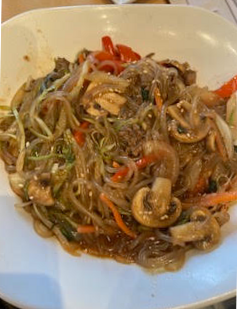
On another BonChon visit, I ordered japchae because it was totally unknown to me. What I got for my curiosity was glass noodles with varied vegetables in soy garlic sauce, sprinkled with sesame seeds. Familiar was the protein: bulgogi because Kyong has made it for me using her mother’s recipe (keep reading for the formula).
Back to japchae: getting the slippery noodles from the bowl to my mouth was a challenge, and the flavor was more mild than expected. One of my dining companions that night said he was expecting a kick. So was I. If you are averse to spice, japchae is the dish for you.
Anxious for Kyong’s assessment at this BonChon stop, we ordered broadly: shrimp shumai (pleasant but ordinary) and crispy chicken strips with sweet and spicy yangnyeom sauce which Kyong confirmed (as the menu states) is a “traditional Korean favorite.” The chicken and its dipping sauce were top notch— a reason to go to BonChon. We also tried bao buns stuffed with cucumbers, coleslaw, spicy mayo and katsu sauce for dipping (satisfying but drippy).
Our waiter warned us that tteokbokki (I should have asked Kyong for a translation, but Wiktionary says it combines “tteok” for “rice cake” and “bokki” for “stir-fried or seasoned food” )
was very spicy. We asked if it could be toned down and he agreed to ask the chef. What arrived, clouded with steam, was a blend of rice cakes, fish cakes (that didn’t taste fishy), onions, peppery sauce (the chef agreed to make it milder) and mozzarella cheese. What?? Mozzarella cheese?
Kyong said it’s very popular in Korea. “We put it on everything.” Who knew? The dish wasn’t intimidatingly-hot, but it was the only entree that went into a doggie bag.
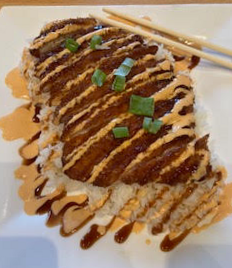
Other choices worth noting from previous visits: Korean cucumber salad (I liked what I sampled from someone else’s order) and chicken katsu featuring the house-specialty chicken breast combined with rice, scallions, spicy mayo and katsu sauce drizzled in a grid pattern atop— it wins BonChon’s beauty contest.
Back to bulgogi: Scott ordered it and ate most of it. “My wife’s is better,” he announced. Kyong shared the marinade she uses: soy sauce, garlic, pear juice, rice wine, sugar or corn syrup and sesame oil. Instead of just a dunk in the sauce, she lets it soak two days before frying. No wonder hers is so flavorful.
BonChon offers only one dessert: Korean donuts dusted with sugar and cinnamon. They could be donuts from anywhere, except they are twisted and served with a sweet cream dipping sauce.
We were done eating and about to leave when the waiter carried a steaming bowl of Tteokbokki (the one we’d asked to be milder) to a couple at the next table. They had bravely ordered it full-bore spicy. Inhaling the fumes, we coughed all the way to the car.